Home / Blog / Mindful Productivity
Education

Mindful Productivity

Sep 17, 2026
3 views
12 min read
Mindful productivity is the practice of being intentionally present, focused, and aware of your current tasks while managing your energy rather than just your time. Unlike traditional productivity, which prioritizes output volume, speed, and constant hustle, mindful productivity focuses on doing the right things with full attention, alignment, and calm efficiency. By shifting the goal from "doing more" to "doing what matters with intention," it prevents burnout and sustains high-quality performance over the long term.
Below is a comprehensive guide to understanding, implementing, and mastering mindful productivity.

Part 1: The Core Philosophy
Traditional productivity operates on a factory-model mentality. It views the human mind as a machine that should ideally run at 100% capacity for eight to ten hours a day. This approach relies heavily on willpower, discipline, and rigid time-management frameworks. While it can produce short-term bursts of high output, it almost inevitably leads to chronic stress, cognitive fatigue, and burnout.
Mindful productivity introduces a paradigm shift by merging the awareness of mindfulness with the execution of productivity. It acknowledges that human energy is cyclical, focus is a finite resource, and mental clarity is the ultimate driver of high-quality work.
The movement is anchored by four central pillars:
  • Intention over Urgency: Choosing actions based on core values and long-term goals rather than constantly reacting to immediate fires, notifications, and external demands.
  • Presence over Multi-tasking: Committing fully to one single task at a time, which reduces the cognitive friction caused by switching between different activities.
  • Energy Management over Time Management: Recognizing that a highly focused hour is vastly more valuable than four hours of exhausted, distracted work.
  • Compassion over Self-Criticism: Accepting that setbacks, distractions, and low-energy days are part of the human experience, and using those moments as data points rather than reasons for guilt.

Part 2: The Psychological Foundations
To understand why mindful productivity works, it helps to look at the cognitive science behind attention and stress.
The Myth of Multitasking
The human brain cannot consciously process two cognitively demanding tasks simultaneously. When you think you are multitasking—such as writing a report while listening to a meeting—your brain is actually engaging in context switching. Each switch incurs a cognitive cost known as an attention residue. A portion of your mental capacity remains stuck on the previous task, leaving you with fewer cognitive resources for the new one. Mindful productivity trains the brain to practice single-tasking, which maximizes cognitive depth and allows you to enter a state of deep flow.
The Role of the Amygdala and Prefrontal Cortex
When we are overwhelmed by a massive to-do list, our brain perceives the workload as a threat. The amygdala (the brain's emotional threat detector) triggers a mild fight-or-flight response. This floods the body with cortisol and adrenaline, impairing the prefrontal cortex, which is responsible for executive function, decision-making, and emotional regulation. Mindful productivity uses grounding techniques and intentional pacing to quiet the amygdala. By keeping the nervous system regulated, you preserve your ability to think critically and creatively.

Part 3: Frameworks for Intentional Planning
Mindful productivity does not reject structure; it reframes it. Instead of filling every minute of the day with tasks, planning becomes a filtering process to protect your time and energy.
The Daily Truncation Method
Rather than writing an exhaustive list of twenty items you hope to accomplish, start each day by identifying your Single Most Important Task (MIT).
  • Ask yourself: If I could only get one thing done today before leaving, which task would make me feel the most fulfilled?
  • Dedicate your peak energy hours to this single item.
  • List no more than two secondary tasks. Anything else completed beyond these three items is a bonus.
The "Energy Mapping" Technique
Time is fixed, but energy fluctuates. For one week, track your energy levels every hour on a scale of 1 to 5. You will likely notice a distinct pattern—such as a peak at 9:00 AM, a crash at 2:00 PM, and a second wind at 4:00 PM.
Once you understand your internal rhythm, map your tasks accordingly:
  • High-Energy Zones: Reserve for deep work, strategic thinking, and complex problem-solving.
  • Low-Energy Zones: Allocate to administrative chores, clearing inbox backlogs, organizing files, or returning low-stakes phone calls.
+-------------------+-----------------------------+-----------------------------+

| Energy Level      | Typical Time Window         | Ideal Task Allocation       |
+-------------------+-----------------------------+-----------------------------+

| High (Peak)       | 08:30 AM - 11:30 AM         | Deep work, writing, strategy|
+-------------------+-----------------------------+-----------------------------+

| Low (Trough)      | 01:30 PM - 03:30 PM         | Inboxes, filing, admin tasks|
+-------------------+-----------------------------+-----------------------------+

| Medium (Rebound)  | 03:30 PM - 05:30 PM         | Collaborative meetings, tidy|
+-------------------+-----------------------------+-----------------------------+

Part 4: Cultivating Deep Focus in a Distracted World
Modern workplaces are designed to fracture attention. Notifications, instant messaging platforms, and open-plan offices create an environment of continuous partial attention. Reclaiming focus requires building external structures and internal habits.
Setting Conscious Boundaries with Technology
Technology should be an active tool, not a passive distraction.
  • Aggressive Notification Filtering: Turn off all non-human notifications. If a machine is buzzing to tell you an app updated or a social media post was liked, it is stealing your attention.
  • Batching Communication: Instead of keeping your email client open all day, check it at three designated times: mid-morning, after lunch, and before wrapping up for the day.
  • Digital De-cluttering: Treat your digital workspace like a physical desk. Keep your desktop clean, close unused browser tabs, and use full-screen modes to eliminate visual distractions while working.
The Mindful Pomodoro Technique
The classic Pomodoro technique (25 minutes of work, 5 minutes of rest) can be adapted to enhance mindfulness.
  • The Transition: Before starting the 25-minute timer, close your eyes and take three deep breaths to anchor your mind to the task.
  • The Work Interval: Work with absolute dedication. If an unrelated thought pops up, write it down on a "distraction pad" to clear it from your working memory, then return gently to the task.
  • The Mindful Break: During the 5-minute break, avoid scrolling on your phone or reading the news. Step away from your screen, stretch, drink water, or look out a window. This allows your brain's default mode network to rest and process information.

Part 5: Managing the Emotional Hurdles
Productivity blocks are rarely a result of poor time management; they are usually a result of poor emotional regulation. We avoid tasks because they make us feel anxious, bored, insecure, or overwhelmed.
Overcoming Procrastination with Curiosity
When you find yourself avoiding a specific project, stop trying to force yourself through sheer willpower. Instead, pause and analyze your internal state with curiosity rather than judgment.
  • Ask yourself: What emotion am I avoiding right now?
  • If the emotion is fear of failure, break the task down into an absurdly small, non-threatening step (e.g., "Open a blank document and write one sentence").
  • If the emotion is overwhelmed by scope, remind yourself that you do not need to finish the project today; you only need to work on it mindfully for twenty minutes.
Deconstructing Perfectionism
Perfectionism is the enemy of progress. It causes over-analysis, endless editing loops, and severe delays. Mindful productivity encourages a mindset of functional excellence. Shift your metric of success from "making this perfect" to "making this clear, useful, and complete." Accept that version one is better than version none, and allow your work to evolve iteratively.

Part 6: Integrating Well-being and Work
You cannot separate the quality of your output from the quality of your physical and mental health. True productivity treats rest not as a reward for hard work, but as a prerequisite for it.
The Practice of Non-Doing
In a culture obsessed with optimization, spending time doing "nothing" is often viewed as a waste. However, strategic periods of non-doing are critical for cognitive recovery. Schedule unscheduled time into your week. Take a walk without a podcast playing, sit quietly with a hot beverage, or simply allow your mind to wander. These unstructured spaces are often exactly where creative insights and solutions to complex problems emerge.
Mindful Transitions
Many professionals struggle to disconnect from work at the end of the day, leading to a state of chronic cognitive activation. Create a clear shutdown ritual to signal to your brain that the workday is officially over.
  • Review what you accomplished.
  • Update your task list for the following day so your mind doesn't try to remember it overnight.
  • Physically close your laptop, clean up your desk space, and take a conscious breath to mark the transition from your professional role to your personal life.

Part 7: Long-Term Sustainability and Habit Building
Adopting mindful productivity is not about implementing a flawless system overnight; it is about building a sustainable lifestyle habit through continuous refinement.
The Weekly Mindful Review
At the end of every week, dedicate thirty minutes to look back and evaluate your systems objectively. Use these three prompt questions to guide your reflection:
  • What did I accomplish this week that aligned closely with my core intentions?
  • Where did I lose my focus or feel my energy drain unnecessarily?
  • How can I adjust my environment, schedule, or expectations next week to support better mental balance?
Cultivating Self-Compassion
There will be days when your focus fractures, unexpected crises derail your schedule, or your energy drops completely. The traditional productivity mindset responds with frustration and harsher discipline. Mindful productivity responds with self-compassion.
Acknowledge that your value as a human being is not tied directly to your daily output. Treat a low-productivity day as a signal that your body or mind needs rest, adjust your plans without guilt, and start fresh the next morning.

Conclusion: The Ultimate Yield of Mindfulness
Ultimately, mindful productivity is about reclaiming control over your life’s scarcest resource: your attention. By working intentionally, protecting your focus, and managing your psychological energy, you can produce exceptional work without sacrificing your health, your relationships, or your peace of mind. True efficiency is not about how fast you run, but about ensuring you enjoy the path you walk and arrive at a destination that actually matters to you.
To help you get started right away, choose one single strategy from this guide to implement tomorrow morning—whether it is identifying your Single Most Important Task, batching your email checks, or taking a screen-free break.
If you want to tailor this framework to your lifestyle, let me know:
  • What industry or type of work do you do?
  • What is your biggest daily distraction (e.g., meetings, chat apps, procrastination)?
  • What does your current planning system look like?
I can help you build an optimized, stress-free routine tailored to your specific goals.

We live in a world obsessed with doing more. More hours. More busy. More output. Productivity advice tends to focus on squeezing every last drop of time and efficiency out of the day and optimising everything up the wazoo, as if gapless calendar is badge of honour.

But what if productivity wasn’t just about doing more, but about doing what actually matters? In a way that’s intentional, sustainable, and aligned with how you work best.

That’s where mindful productivity comes in.

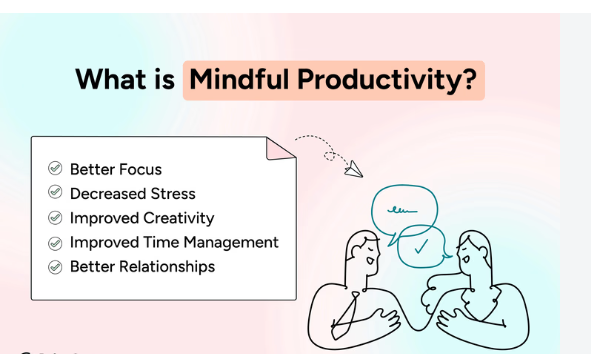
What Is Mindful Productivity?

Many definitions of mindful productivity focus on productivity grounded in presence, balance and sustainability. All crucial elements. But they often miss something deeper.

Mindfulness, at its core, isn’t just about self-awareness. It’s also about interconnection, compassion and intentional impact. It’s about recognising that how we work doesn’t just affect us, it affects the people around us, our communities and the systems we operate within.

Without these elements, mindful productivity risks becoming just another individualistic pursuit of better self-optimisation. When in reality, it’s about working in a way that supports both personal and collective wellbeing.

Mindful Productivity: A Deeper Definition

Mindful productivity is the practice of sustainable, intentional and meaningful action informed by conscious awareness and acceptance of your unique mental, emotional and physical state, innate nature and needs — within the context of our interconnected human experience. It empowers you to engage in focused flow, supporting both personal and collective care, wellbeing and impact.

After burning out a few times in my life as a creator and entrepreneur, I had to learn some important lessons and tools to make all this sustainable.

I love creating, working on my business, sharing my ideas, and helping people - it brings me a lot of meaning and fulfills me.

But this striving for more growth and to keep up with social media algorithms plus the disconnection from my body in the past led me to experience more pressure than was healthy for my mind and body.

As a creator, it's hard to draw the line between what's "living" and what's "creating and working".

It all sort of blends together, because it's all fun and games most times - which was my intention from the start back in 2011 - to not live a 9-5, where life and work is clearly separated. All this also came with its challenges.

I eventually realized that my capacity to create and help others is directly linked to my mental, emotional, and physical health. It is all one.

In order to not only stay healthy but wealthy in a holistic manner, I had to:

  • question conventional ideas of productivity and success.

  • apply mindfulness + awareness to all areas of life.

Enter mindful productivity.

In its simplest terms, I define it as the combination of mindfulness and productivity.

This means bringing a more present and conscious quality to creating and working while being closely tuned into my emotions, mental state and physical sensations - and taking actions to strengthen this connection, be more self-compassionate, and managing my nervous system responses.

Today, I experience more mental clarity, more flow, more energy. My body and mind are healthier and happier. I feel more connected to my purpose.