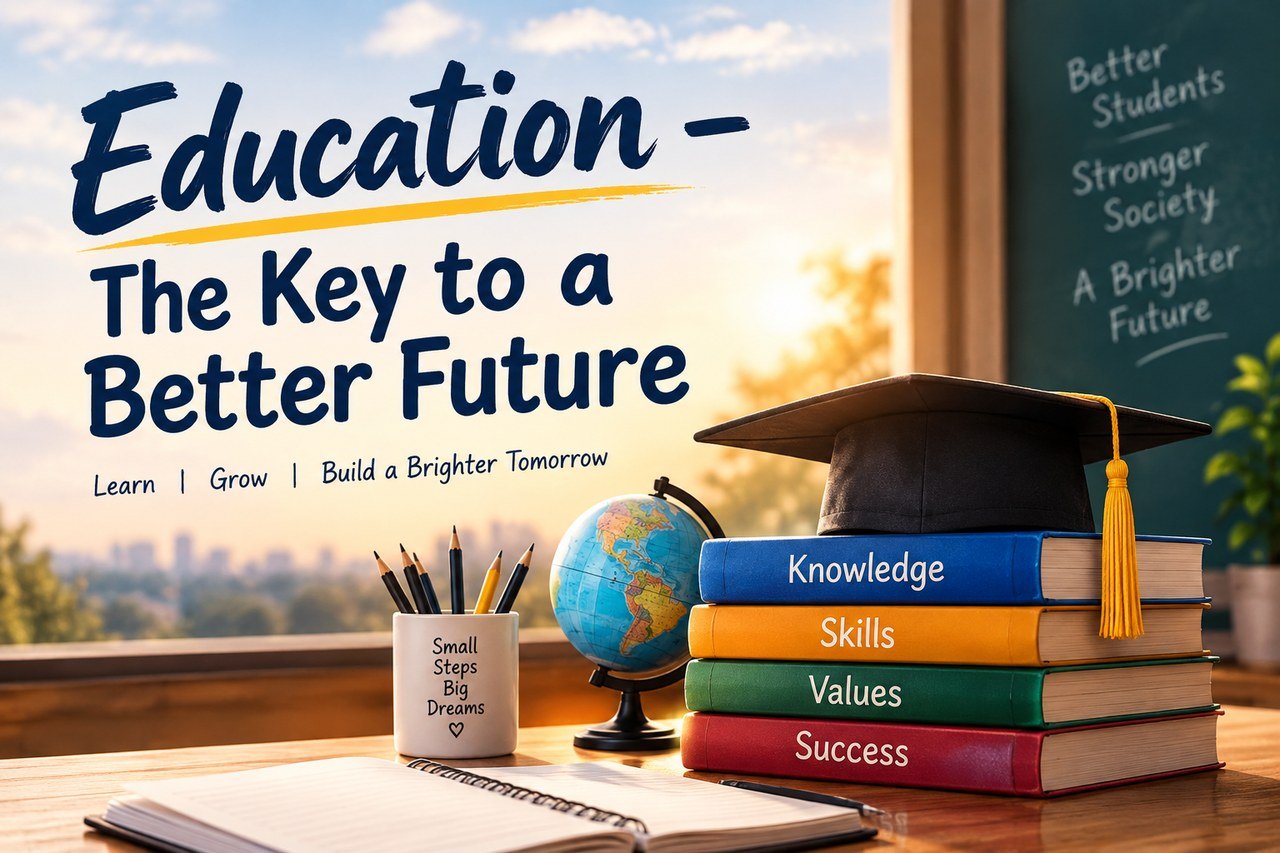
Education – The Key to a Better Future
Education is one of the most important parts of our life. It is not only about reading books, attending classes, or getting good marks in exams. Education teaches us how to think, how to understand the world around us, and how to make the right decisions in life. It helps us become better and more responsible individuals.
In today’s world, education has become more important than ever. The world is changing very quickly, and new technology and information are becoming a part of our daily lives. With proper education and knowledge, we can understand these changes and adapt to them. Education also gives us confidence and motivates us to work hard and achieve our dreams.
Education is not only useful for getting a good job. It also teaches us important values such as honesty, discipline, respect, kindness, and responsibility. A well-educated person can understand the difference between right and wrong and can make better choices in difficult situations.
Education also plays an important role in the development of our country. Students who receive good education can become doctors, engineers, teachers, scientists, artists, entrepreneurs, and professionals in many other fields. Their knowledge and skills can help solve problems and contribute to the growth of society and the nation.
However, even today, many children do not get proper educational opportunities. Poverty, lack of facilities, and other problems can stop children from continuing their studies. Every child deserves the opportunity to learn and build a better future. Providing quality education to everyone should therefore be an important goal of society.
Education also helps us discover our interests and abilities. Every person has different talents, and education gives us an opportunity to understand and develop them. It teaches us that failure is not the end, but a chance to learn and improve ourselves.
In conclusion, education is much more than a way to pass examinations or get a job. It is a lifelong journey that helps us grow as individuals and understand the world better. Knowledge gained through education stays with us throughout our lives. If we want to create a better future for ourselves and our country, we must give education the importance it truly deserves.
“Education is the light that helps us find the right path in life.”
Education: The Foundation of a Better Tomorrow
Education is one of the most powerful forces in the world. It has the ability to change individuals, transform societies, and shape the future of nations. When we hear the word “education,” we often think about classrooms, textbooks, examinations, marks, and degrees. However, true education goes far beyond these things. It teaches us how to think, how to understand life, how to face challenges, how to communicate with others, and how to become responsible human beings.
Education is not simply the process of collecting information. It is the process of developing our mind, character, skills, and understanding. A person may have many degrees but still lack kindness, responsibility, or the ability to make sensible decisions. On the other hand, a person who has learned from experience, mistakes, teachers, books, and life may possess great wisdom. Therefore, education should not be measured only by examination results. Its real value can be seen in the way it changes a person's thoughts, behaviour, confidence, and attitude towards life.
From the very beginning of our lives, we learn something new every day. A child first learns from parents and family, then from teachers, friends, books, experiences, and the world around them. In this way, education is not limited to a classroom. It is a lifelong journey of learning and growth. Even after completing school or college, we continue to learn through our careers, relationships, successes, failures, and experiences.
Education Gives Us the Power to Dream
One of the greatest benefits of education is that it gives us the confidence to dream. A student may begin with a simple dream of becoming a doctor, engineer, teacher, artist, entrepreneur, scientist, athlete, or civil servant. Education gives that student the knowledge and skills needed to turn that dream into a realistic goal.
Imagine a student sitting in a classroom and listening to a teacher explain how a bridge is designed. That lesson may seem ordinary at first, but it could inspire the student to become an engineer. Another student may read about space and become interested in astronomy. Someone else may discover a love for literature and decide to become a writer. This is the power of education: it opens doors to possibilities that we may not even know exist.
Education also teaches us that failure is not the end. Students often feel disappointed when they receive low marks or fail an examination. But failure can become an important teacher. It shows us where we need improvement and encourages us to try again. A student who learns how to handle failure develops a quality that is useful far beyond the classroom.
A Student-Centered Example
For example, imagine a student who comes from a financially struggling family. At first, the student may not have access to expensive coaching classes, private tutors, or the latest learning resources. The student may even feel that achieving a big dream is impossible.
However, a supportive teacher notices the student's potential and encourages them not to give up. The student begins using the school library, borrowing books from friends, studying regularly, and using free educational resources available online. Mathematics, which once seemed extremely difficult, slowly becomes easier through consistent practice.
After months of effort, the student performs well in an examination. More importantly, the student gains confidence and begins helping classmates who are struggling with the same subject. The student learns that knowledge becomes even more valuable when it is shared with others.
This example shows that education is not only about marks or certificates. It can build confidence, determination, discipline, independence, and the willingness to help others. Sometimes, one encouraging teacher or one opportunity to learn can change the direction of a student's entire life.
The Role of Teachers
Teachers are among the most important people in the educational journey of a student. A good teacher does much more than complete a syllabus. Teachers guide students, answer their questions, encourage their curiosity, and help them recognize their strengths.
A teacher may notice potential in a student before the student notices it themselves. Sometimes a few words of encouragement from a teacher can give a student the confidence to continue working towards a difficult goal.
Teachers also teach lessons that are not written in textbooks. Through their behaviour, they can teach punctuality, patience, discipline, respect, honesty, and responsibility. A classroom can therefore become more than a place where students study subjects. It can become a place where they learn how to live and work with others.
At the same time, students also have a responsibility. Teachers can show us the path, but we have to walk on it ourselves. Students should develop curiosity, ask questions, read regularly, practise their skills, and learn from their mistakes.
Education and Character Building
Education also plays an important role in developing our character. A highly educated person is not necessarily someone who has simply collected many certificates. True education teaches values such as honesty, discipline, kindness, patience, respect, empathy, and responsibility.
Imagine a student who scores the highest marks in the class but refuses to help anyone. Another student may score slightly fewer marks but regularly helps classmates, respects teachers, accepts mistakes, and treats everyone kindly. Academic performance is important, but character is equally important for building a meaningful life.
Education should therefore help students become not only successful professionals but also good human beings. Knowledge without values can sometimes be misused. When knowledge is combined with responsibility and compassion, it becomes a force for positive change.
Education in the Age of Technology
Technology has completely changed the way we learn. In the past, students depended mainly on textbooks, classrooms, libraries, and teachers. Today, students can access educational videos, digital libraries, online courses, interactive applications, virtual laboratories, and information from different parts of the world.
Technology has made learning more accessible and flexible. A student who does not understand a topic in class can watch another explanation online. A student interested in a particular subject can explore it beyond the school syllabus. Students can also communicate with people from different cultures and learn about ideas that may not be available in their immediate surroundings.
However, technology also brings challenges. The internet contains both useful information and misinformation. Students may become distracted by social media, entertainment, or excessive screen time. Therefore, education must teach students not only how to use technology but also how to use it responsibly.
The ability to identify reliable information, think critically, protect personal information, and avoid blindly believing everything found online has become an important part of modern education.
Education and Critical Thinking
One of the most valuable things education can give us is the ability to think independently. We live in a world where information is available everywhere. We hear opinions from friends, television, social media, websites, and many other sources.
Education teaches us to ask questions: Is this information true? What is the evidence? Are there different points of view? What can I learn from this situation?
Critical thinking helps students become independent decision-makers. Instead of simply accepting an idea because someone else said it, an educated person learns to examine it carefully. This skill is useful in education, careers, relationships, and everyday life.
A student who learns to think critically is better prepared to solve problems instead of waiting for someone else to provide every answer.
Education and Career
Education is also an important foundation for a successful career. Different professions require different forms of knowledge and skills. A doctor needs medical knowledge, an engineer needs technical skills, a teacher needs subject knowledge and communication skills, and an entrepreneur needs creativity, planning, leadership, and decision-making abilities.
However, education should not encourage students to believe that only a few professions are valuable. Every honest profession has a role in society. A country needs doctors and engineers, but it also needs teachers, farmers, designers, technicians, researchers, artists, skilled workers, entrepreneurs, and many others.
Students should be encouraged to understand their interests and abilities rather than blindly following a career simply because it is considered prestigious. A successful career is more meaningful when it matches a person's abilities, interests, values, and dedication.
Education and Equality
Education has the power to reduce inequality. A child born into a poor family should still have the opportunity to learn, develop skills, and build a successful future. Education can provide opportunities that may otherwise remain out of reach.
Unfortunately, many children still face difficulties such as poverty, lack of schools, inadequate learning facilities, family responsibilities, distance from educational institutions, or limited access to technology. These challenges can prevent talented students from reaching their full potential.
This is why providing quality education to every child is so important. Education should not be treated as a privilege available only to those who can afford it. Every child deserves a chance to learn, ask questions, develop skills, and dream about the future.
Education and the Progress of a Nation
The progress of a country is closely connected with the quality of education available to its people. Doctors, engineers, teachers, scientists, entrepreneurs, artists, farmers, researchers, and skilled workers all contribute to society in different ways.
When people receive quality education and develop useful skills, they can contribute more effectively to their families, communities, and nation. Educated citizens are better equipped to understand social issues, participate responsibly in society, and contribute new ideas.
A country's greatest resource is not only its natural wealth or technology. Its people are also a tremendous resource. When young people receive opportunities to learn and develop their abilities, they can become a powerful force for progress.
Therefore, investing in education is not just an investment in students; it is an investment in the future of the entire country.
The Importance of Practical Education
Another important aspect of modern education is practical learning. Students should not only memorize information for examinations. They should also understand how knowledge can be applied in real life.
For example, learning mathematics becomes more meaningful when students understand how it is used in budgeting, business, engineering, science, or everyday decisions. Learning science becomes more interesting when students conduct experiments and observe results. Learning language becomes more useful when students practise communication, writing, presentations, and public speaking.
Practical education helps students connect classroom knowledge with the real world. It also develops problem-solving skills and creativity.
Schools and colleges can encourage students to participate in projects, debates, competitions, sports, cultural activities, science exhibitions, community service, and other activities. Such experiences can help students discover talents that may not be visible through written examinations alone.
Education and Emotional Growth
Education should also help students understand their emotions and develop healthy relationships with others. Student life can sometimes be stressful. Students may face pressure related to examinations, expectations, competition, friendships, or their future careers.
A supportive educational environment can teach students that asking for help is not a weakness. It can encourage communication, cooperation, empathy, and respect.
Students should learn that everyone develops at a different pace. Comparing ourselves constantly with others can create unnecessary pressure. Education should encourage students to focus on personal growth and continuous improvement.
Education Is a Shared Responsibility
Education is not the responsibility of schools alone. Parents, teachers, communities, governments, institutions, and students all have important roles to play.
Parents can create an environment where learning is encouraged. Teachers can guide students and make classrooms more engaging. Schools and colleges can provide opportunities and resources. Communities can support children who face difficulties. Students themselves must take responsibility for their learning.
When all these parts work together, education becomes much more effective.
Challenges in Modern Education
Although education has made great progress, several challenges remain. In some places, students still lack access to quality teachers and learning resources. In other situations, education may become too focused on examinations and marks.
Examinations are important, but they should not become the only measure of a student's ability. Students have different strengths. Some may be excellent at mathematics, while others may be talented in art, music, sports, communication, leadership, technology, or creative thinking.
A good education system should recognize and encourage different kinds of talent.
Another challenge is the pressure students sometimes experience to achieve perfect results. Competition can motivate students, but excessive pressure can reduce their enjoyment of learning. Education should create curiosity rather than fear.
The Future of Education
The future of education is likely to be more connected with technology, creativity, practical skills, and lifelong learning. Jobs are changing, and new careers are emerging. Students entering the workforce in the future may work in professions that do not even exist today.
Therefore, students need more than memorized information. They need adaptability, creativity, communication, collaboration, digital skills, and the ability to learn continuously.
The most important skill of the future may be the ability to keep learning. Knowledge changes quickly, but a person who knows how to learn can continue growing throughout life.
Conclusion
In conclusion, education is much more than a pathway to a successful career. It is a foundation upon which a meaningful life can be built. It gives us knowledge to understand the world, wisdom to make better choices, confidence to pursue our dreams, and courage to face the future.
Education can change the life of a single student, but the impact does not stop there. That student may later become a teacher who inspires another generation, a doctor who serves patients, an engineer who creates useful solutions, an entrepreneur who provides employment, or simply a responsible citizen who contributes positively to society.
The true purpose of education is therefore not just to create successful individuals, but to create thoughtful, responsible, capable, and compassionate human beings.
As Nelson Mandela famously said, “Education is the most powerful weapon which you can use to change the world.”This idea reminds us that education has the power to create opportunities, break barriers, and open doors to a better future.
Every student deserves the opportunity to learn. Every teacher deserves the opportunity to inspire. And every society benefits when knowledge is valued and shared.
We should therefore look at education not as a burden of homework, examinations, and marks, but as an opportunity to discover ourselves and understand the world around us.
A book may teach us a fact, a teacher may teach us a lesson, and an experience may teach us wisdom. Together, they shape who we become.
Education does not simply prepare us for life; it teaches us how to make life better.