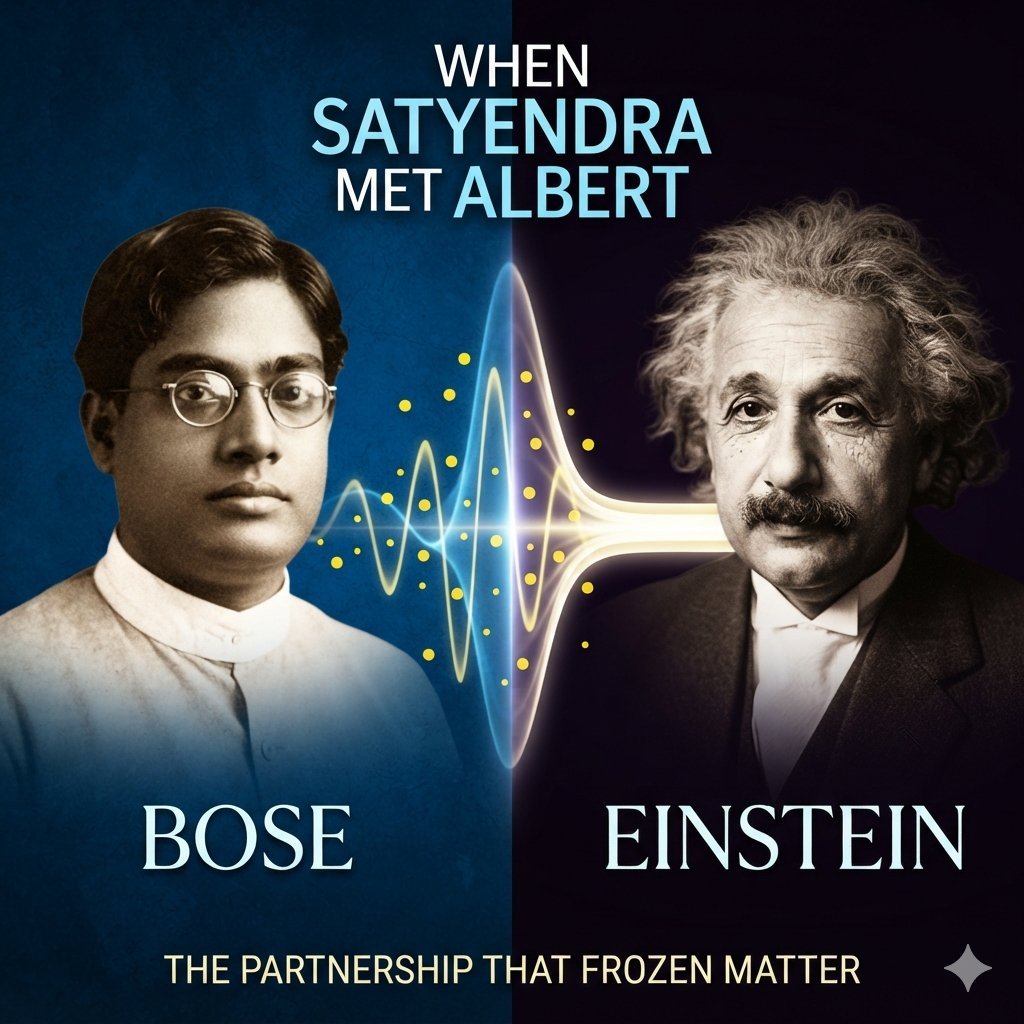
Introduction: The Threshold of the Unseen
In the early 1920s, a lone Indian scholar in colonial Calcutta fundamentally re-imagined the quantum world. When his ideas collided with Albert Einstein’s, they predicted a bizarre fifth state of matter that challenged the laws of nature—and took humanity seven decades to actually build.
In the early decades of the twentieth century, physics was a discipline fractured by its own success. The macro-world—the comfortable, deterministic universe governed by Sir Isaac Newton’s laws of motion and James Clerk Maxwell’s equations of electromagnetism—was crumbling at its foundations. Classical mechanics could predict the orbits of planets and the trajectory of artillery shells with flawless precision, yet it fell utterly silent when confronted with the behavior of the subatomic. The atom, once thought to be an indivisible, solid billiard ball, had revealed itself to be a chaotic, deeply counterintuitive realm of probability, discrete energy packets, and ghostly wave-particle dualities.Max Planck had opened the Pandora’s box of the quantum in 1900 by suggesting that energy is emitted in discrete packets, or "quanta." Albert Einstein had expanded upon this in 1905, proposing that light itself is composed of localized particles—photons—rather than just continuous waves. Yet, by the early 1920s, the foundational mathematics governing these quantum entities remained a patchwork of classical approximations and ad-hoc assumptions. The physics community was desperately searching for a unified, mathematically rigorous language that could describe the crowd behavior of these subatomic particles.The answer would not emerge from the prestigious, well-funded laboratories of Berlin, Copenhagen, or Paris. Instead, the crucial spark came from Dacca and Calcutta, thousands of miles away from the European epicentre of science. It arrived in the form of a neatly handwritten manuscript, penned by a relatively unknown thirty-year-old Indian physicist named Satyendra Nath Bose. When that manuscript landed on the desk of Albert Einstein in Berlin, it ignited a creative partnership that would redefine the boundaries of matter, predict an entirely new state of existence, and ultimately teach humanity how to make matter stand perfectly still.
THE TIMELINE OF A QUANTUM REVOLUTION
1900 ─── Max Planck proposes that energy is emitted in discrete packets ("quanta").
1905 ─── Albert Einstein introduces the light-quantum hypothesis (the photon).
1924 ─── Satyendra Nath Bose sends his revolutionary paper to Einstein from Dacca.
1925 ─── Einstein expands Bose's math, predicting the Bose-Einstein Condensate (BEC).
1995 ─── Cornell, Wieman, and Ketterle create the first real BEC in a laboratory.
2018 ─── NASA launches the Cold Atom Lab to study BECs in Earth's orbit.
The Crucible of Calcutta
To understand the profound nature of this intellectual collision, one must first look at the unique cultural and scientific crucible that shaped Satyendra Nath Bose. Born in Calcutta (now Kolkata) on New Year's Day in 1894, Bose was the eldest and only son among seven children. His father, Surendranath Bose, was an accountant in the Engineering Department of the East Indian Railway—a man of mathematical inclination who would write out arithmetic problems on the floor for his young son to solve before leaving for work.Bose grew up breathing the intoxicating air of the Bengal Renaissance, a spectacular socio-cultural and intellectual awakening that swept through undivided Bengal. Calcutta at the turn of the century was a city of stark contradictions: it was the fierce political beating heart of the British Raj, but also an explosive incubator for art, literature, and radical scientific defiance.Bose’s genius flourished early at the legendary Hindu School, where his mathematics teacher famously awarded him 110 marks out of 100 on an exam because the boy had not only solved every problem correctly but had also devised multiple entirely unique methods to reach the answers.When Bose entered Presidency College, Calcutta, in 1909, he found himself embedded in a golden generation of Indian intellect. His classmates included Meghnad Saha, who would go on to revolutionize astrophysics with his thermal ionization equation, and Prasanta Chandra Mahalanobis, the future giant of modern statistics. They studied under legendary mentors: Sir Jagadish Chandra Bose, the polymath who pioneered wireless communication and biophysics, and Sir Prafulla Chandra Ray, the father of modern Indian Chemistry. This was not a passive education; it was an act of anti-colonial resistance. These young scholars were driven by a collective, burning desire to prove that Indian minds could operate at the absolute vanguard of global science, completely independent of Western oversight.By the time Bose completed his Master’s degree in Applied Mathematics in 1915—shattering university records that stand to this day—a fresh crisis struck. World War I broke out, effectively cutting off India from European scientific journals. For Bose and Saha, newly appointed as lecturers at the University College of Science founded by Sir Asutosh Mookerjee, tracking down the latest breakthroughs in physics became a treasure hunt. They had to borrow German-language textbooks from the private library of Dr. Prafulla Chandra Ray and teach themselves German, French, and Dutch just to read the latest papers by Max Planck, Niels Bohr, and Albert Einstein.It was this profound resourcefulness, forged in the isolated libraries of Calcutta, that gave Bose a rare quality: a fiercely independent mind that refused to accept established dogmas on authority alone. He did not merely memorize equations; he tore them apart to find the deep logical truths hidden beneath the calculus.
The Solitary Scholar of Dacca
In 1921, the academic landscape shifted. Bose moved from Calcutta to take up a position as a Reader in Physics at the newly established University of Dacca (now Dhaka, Bangladesh). If Calcutta was an incubator, Dacca was an isolation chamber. The university’s physics department was young, underfunded, and lacking even basic modern laboratory apparatus. Yet, it was here, away from the chatter of mainstream academia, that Bose ran headfirst into the conceptual wall that would define his career.
While preparing a lecture for his postgraduate students on the theory of radiation and the "ultraviolet catastrophe," Bose began examining Max Planck’s famous radiation law. Planck had successfully predicted the spectrum of light emitted by a hot, glowing object (a blackbody), but his derivation was mathematically messy. To get the math to work, Planck had sneakily relied on classical electrodynamics—principles that fundamentally contradicted the very quantum nature he was trying to prove.
Bose recognized this logical hypocrisy. The mainstream physics community had largely tolerated it because the formula worked. Bose, however, decided to treat photons strictly as quantum particles, completely discarding classical wave theory.
He sat down at his desk in Dacca and began to rethink the statistics of light from scratch. He realized that the error lay in how physicists counted configurations of light. If you toss two normal coins, there are four possible outcomes: Heads-Heads, Tails-Tails, Heads-Tails, and Tails-Heads. The chance of getting one of each is 50%. This is standard, classical probability.
Bose made a radical, seemingly absurd assumption: what if quantum particles like photons are absolutely identical and indistinguishable? If you cannot tell one photon apart from another, the distinction between Heads-Tails and Tails-Heads completely vanishes. In Bose’s quantum coin toss, there are only three possible outcomes: two Heads, two Tails, or one of each. Each outcome carries an equal 33.3% probability.
This subtle shift in perspective changed everything. By treating photons as completely indistinguishable entities that had no reservations about occupying the exact same physical state, Bose derived Planck’s radiation law cleanly, elegantly, and without a single shred of classical physics.
Excited, Bose sent his paper, titled “Planck’s Law and the Light Quantum Hypothesis,” to the British journal Philosophical Magazine. The editors summarily rejected it. They viewed his mathematical counting trick as an error rather than a profound insight.Refusing to let his work die in obscurity, Bose took a daring gamble. On June 4, 1924, he placed the manuscript into an envelope and addressed it directly to the most famous scientist on the planet: Professor Albert Einstein in Berlin.
The Berlin Seer and the Act of Translation
In 1924, Albert Einstein was at the absolute zenith of his global fame. His General Theory of Relativity had been spectacularly confirmed by the 1919 solar eclipse expeditions, turning him into a household name. Yet, scientifically, Einstein was increasingly isolated. He watched with growing unease as the younger generation of European physicists—led by Niels Bohr and Werner Heisenberg—began steering quantum mechanics toward a world governed entirely by randomness, uncertainty, and statistical ghosts. Einstein famously loathed the idea that "God plays dice with the universe." When Bose’s letter arrived at Einstein’s apartment in Berlin, the great physicist sat down to read it. He immediately recognized the sheer genius glowing within the Indian scholar's work. Where the British editors had seen a mathematical eccentricity, Einstein saw an elegant revolution. Bose had provided the missing foundational pillar for the quantum theory of light.Einstein did not just passively approve of the paper; he personally translated it from English into German. He added a glowing, historic postscript of his own to the text before submitting it to the prestigious Zeitschrift für Physik:"Bose's derivation of Planck's formula signifies, in my opinion, a magnificent step forward. The method used here also yields the quantum theory of an ideal gas, as I shall show elsewhere." The paper was published in August 1924. Almost overnight, the unknown researcher from Dacca was thrust into the international spotlight. Einstein’s validation acted as a golden passport. When Bose subsequently travelled to Europe on a study leave, the doors of the world's elite laboratories—from Marie Curie’s Radium Institute in Paris to Max Born’s seminar rooms in Göttingen—flew open for him.
The Birth of the Ideal Gas Theory
Einstein did not stop at merely translating Bose's work. His mind, always searching for universal symmetries, immediately began expanding Bose’s mathematical framework. Bose had designed his new statistics specifically for photons—particles of light, which are massless and can be created or destroyed at will. Einstein asked a monumental "what if": What happens if we apply Bose's revolutionary indistinguishable statistics to material atoms? What happens if we apply it to a gas made of real, physical particles that possess mass and cannot vanish into thin air?
Through late 1924 and early 1925, Einstein published a series of groundbreaking papers before the Prussian Academy of Sciences, developing what is now known as Bose-Einstein Statistics.
In doing so, he divided the subatomic world into two grand, warring empires. Particles like electrons, protons, and neutrons—which are fiercely antisocial and refuse to occupy the same quantum state—would later be named fermions (after Enrico Fermi). But particles like photons, and certain symmetrical atoms that joyfully gather together, were named bosons in perpetuity, immortalizing the young scientist from Calcutta.
As Einstein deeply probed the mathematical landscape of an ideal gas composed of these bosons, he hit upon a bizarre mathematical singularity. He noticed that if you take a cloud of these material bosons and steadily drain them of their thermal energy—cooling them down toward the theoretical limit of absolute zero (-273.15 °C or 0 Kelvin) —something extraordinary occurs.
At normal temperatures, the atoms in a gas behave like a chaotic, raucous crowd at a train station. Each atom moves independently, zipping around at different speeds, possessing its own unique energy and momentum. In the language of quantum mechanics, each atom is represented by a tiny wave packet, and these waves are small, disjointed, and scattered.
However, as the temperature plunges toward absolute zero, the atoms lose their frantic kinetic energy. They slow down to a crawl. Because of Louis de Broglie’s wave-particle duality hypothesis, as a particle slows down, its quantum wavelength grows larger.
Einstein’s equations predicted that at a critically low, sub-microscopic temperature, these expanding atomic waves would begin to touch. They would overlap. They would bleed into one another.
Then, in a sudden, dramatic phase transition, the individual identities of the atoms would vanish entirely. The thousands or millions of separate atoms would drop into the absolute lowest possible energy state—the quantum ground state. They would lock together, merging their individual identities to form a single, massive, macroscopic quantum entity.
It was no longer a collection of individual particles; it had become a collective super-atom. The crowd had begun to march in perfect, flawless lockstep. Matter, quite literally, stood still.
Einstein had predicted the Bose-Einstein Condensate (BEC)—the fifth state of matter, distinct from solids, liquids, gases, and plasmas.
The Grand Cryogenic Symphony
The hunt for the fifth state of matter lay dormant for decades, waiting for technology to catch up with the visionary mathematics of 1924. That renaissance finally arrived in the late 1980s and 1990s, sparked by an ingenious combination of two cutting-edge technologies: laser cooling and magnetic trapping.
To understand how scientists attacked this problem, one must appreciate the sheer irony of the solution: using burning-hot lasers to freeze atoms in place.
When an atom moves toward a laser beam, it absorbs the incoming photons. Because photons carry momentum, each collision acts like a tiny, subatomic tennis ball hitting a speeding semi-truck. If the laser light is tuned to just the right frequency (a technique known as Doppler cooling, pioneered by Steven Chu, Claude Cohen-Tannoudji, and William Phillips), the atom is hit only when it moves toward the light. Millions of these tiny impacts slow the atom down from bullet-like speeds to a leisurely crawl, dropping the temperature of the atomic cloud to mere fractions of a Kelvin.
Yet, laser cooling alone was not enough to cross the finish line. To reach the holy grail of physics, scientists had to devise a way to hold these ultra-cold atoms without letting them touch the warm walls of a container. The solution was the magneto-optical trap—a cage made entirely of invisible magnetic fields and light that suspended the cloud of atoms in the middle of a ultra-high vacuum chamber.
The final push occurred in 1995 at JILA, a joint institute of the National Institute of Standards and Technology (NIST) and the University of Colorado at Boulder. Two physicists, Eric Cornell and Carl Wieman, chose to work with rubidium-87, an alkali metal whose atomic properties made it an ideal candidate for Bose-Einstein condensation.
Cornell and Wieman utilized a brilliant technique called evaporative cooling. Imagine a hot cup of coffee: the fastest, hottest water molecules escape as steam, leaving the remaining liquid cooler. The scientists lowered the magnetic walls of their atomic trap just enough to let the faster, hotter rubidium atoms escape. The remaining atoms collided, shared their energy, and settled into a much deeper state of cold.
It was a grueling, delicate process. At exactly 10:54 AM on June 5, 1995—almost seventy-one years to the day after Bose sent his letter to Einstein—the temperature of the rubidium cloud dropped to a staggering 170 nanokelvins (170 billionths of a degree above absolute zero).
Suddenly, the computer monitors monitoring the velocity distribution of the atoms registered a massive, unmistakable spike. The chaotic cloud had collapsed. The individual atoms had vanished, replaced by a single, dense, high-profile peak right at the center of the trap.
Matter had frozen into the fifth state. The Bose-Einstein Condensate was no longer a myth.
A few months later, Wolfgang Ketterle at the Massachusetts Institute of Technology (MIT) achieved the same historic milestone independently using sodium atoms, producing a condensate large enough to be photographed and manipulated. In 2001, Cornell, Wieman, and Ketterle were awarded the Nobel Prize in Physics, fulfilling the legacy of the two men whose journey had started seven decades prior.
Playground of the Quantum Giants
The confirmation of the Bose-Einstein Condensate opened up a vast, pristine playground for quantum exploration. In a normal solid, liquid, or gas, quantum effects are deeply buried beneath the chaotic thermal noise of everyday life. We cannot see quantum mechanics with the naked eye because everything is moving too fast, smashing together in an erratic frenzy. But a Bose-Einstein Condensate is a magnifying glass for the quantum world. Because millions of atoms occupy the exact same quantum state, the bizarre, macroscopic properties of quantum mechanics become visible on a scale we can directly observe.
One of the most mind-bending applications of this state of matter involves the manipulation of light itself. In 1999, Danish physicist Lene Hau led a research team that shone a laser through a Bose-Einstein Condensate of sodium atoms. Light, which normally races through the vacuum of space at a blinding 300,000 kilometers per second, was slowed down inside the condensate to a mere 61 kilometers per hour—slower than a car driving down an open highway. Later experiments even managed to stop the light pulse entirely inside the cloud, storing it before releasing it unharmed.
Furthermore, BECs have paved the way for the development of atom lasers. While a standard laser fires a highly concentrated stream of coherent photons, an atom laser emits a stream of coherent atoms. Because atoms have much shorter wavelengths than light, atom lasers could eventually be used to create nanotechnology with atomic-scale precision, drawing computer circuits with individual atoms.
Today, Bose-Einstein research has even traveled beyond Earth. In 2018, NASA launched the Cold Atom Lab (CAL) to the International Space Station. In the microgravity of space, away from the distorting pull of Earth's gravity, scientists can hold condensates in traps for much longer periods, cooling them to even lower records—picokelvins—and probing the fundamental laws of quantum gravity at the very edge of human understanding.
Two Minds, One Wave
The story of the Bose-Einstein theory is more than just a timeline of academic milestones and laboratory breakthroughs. It stands as a profound testament to the universal, borderless nature of human thought.
In 1924, two men who could not have been more different on the surface—one an idealistic Indian scholar working in a modest colonial university, the other a globally celebrated European icon navigating the turbulent politics of Weimar Germany—found a common language in the absolute elegance of mathematics. They did not need a physical laboratory to see into the heart of nature; they used pure reason to peer into a dark, frozen frontier that humanity would not possess the technology to touch for nearly three-quarters of a century.
When Satyendra met Albert through the simple medium of an ink-stained letter, they rewrote the rules of the cosmos. They proved that at the fundamental layer of reality, nature values unity over individuality, allowing an unruly crowd of separate particles to sing together in a single, beautiful, silent quantum choir. In doing so, they left an indelible mark on history, reminding us that the coldest places in the universe will always be illuminated by the warmth of human curiosity.