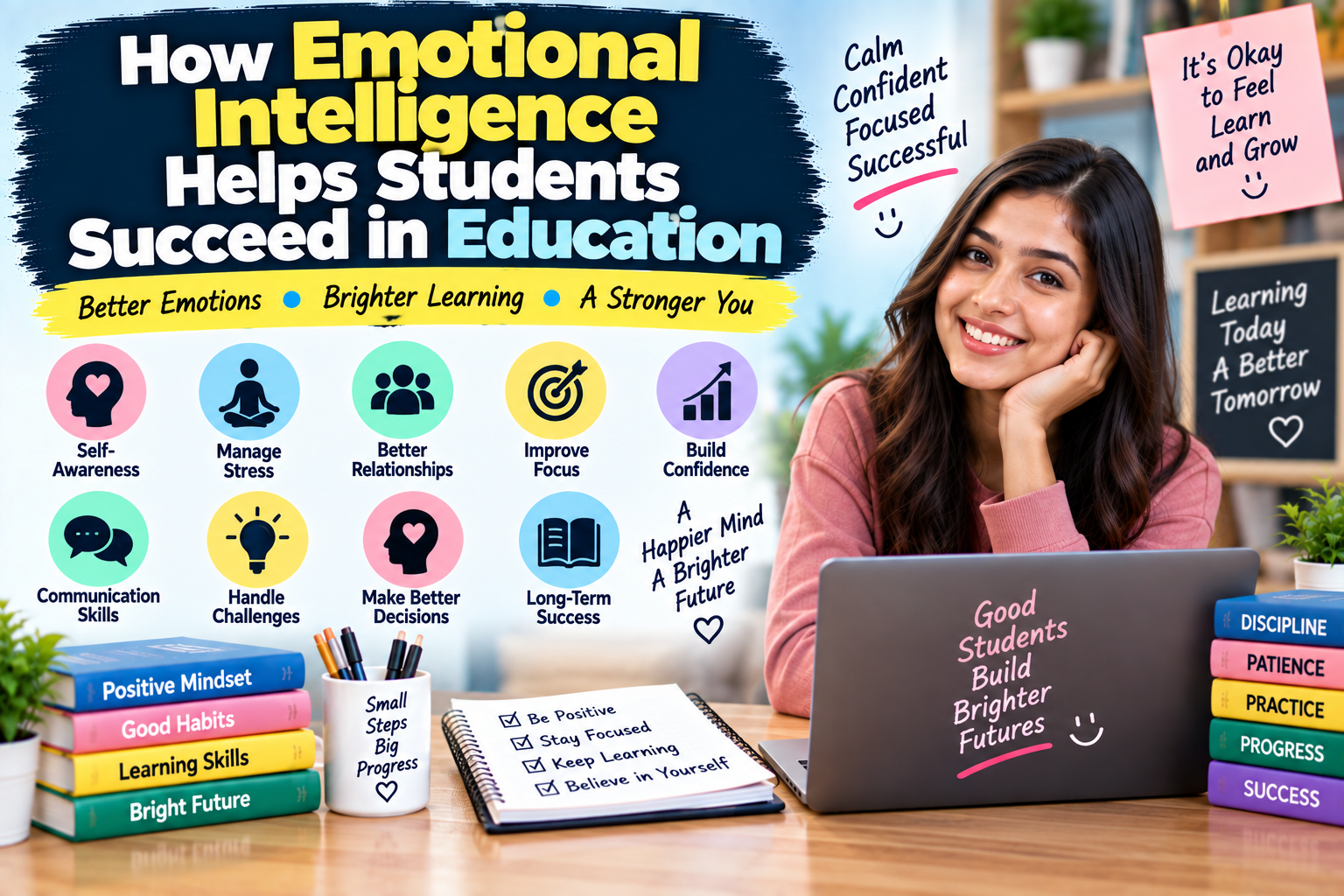
How Emotional Intelligence Helps Students Succeed in Education
Introduction
Education is not only about textbooks, examinations, marks, and academic knowledge. Students also need to understand their emotions, communicate with others, handle pressure, make responsible decisions, and build healthy relationships. These abilities are closely connected with emotional intelligence.
Emotional intelligence refers to the ability to recognize, understand, manage, and appropriately express emotions. It also includes understanding the feelings of other people and responding to them in a sensible way. For students, emotional intelligence can influence how they deal with academic pressure, friendships, teachers, failures, challenges, and important decisions.
A student may have strong academic knowledge but still face difficulties when they cannot manage frustration, anxiety, anger, disappointment, or pressure. Similarly, a student with average academic performance may make steady progress because they can manage their emotions, ask for help, communicate effectively, and continue working after facing difficulties.
Modern education therefore needs to consider both academic development and personal development. Emotional intelligence can help students become more balanced learners and prepare them for situations they may face beyond the classroom.
What Is Emotional Intelligence?
Emotional intelligence is the ability to understand and manage emotions in ourselves and recognize emotions in others. It is not about ignoring emotions or pretending to be happy all the time. Instead, it means understanding what we are feeling and choosing an appropriate response.
For example, a student may feel nervous before an examination. Emotional intelligence does not mean removing the nervous feeling immediately. It means recognizing the feeling, understanding its possible cause, and using a healthy strategy such as preparation, breathing exercises, organizing study time, or talking to someone for support.
Emotional intelligence can involve several important abilities, including self-awareness, self-management, empathy, communication, and relationship skills.
These abilities can be developed gradually through practice and experience.
Why Emotional Intelligence Matters in Education
Students experience many different emotions during their educational journey. They may feel excited after achieving good marks, disappointed after receiving low marks, nervous before an examination, frustrated when they do not understand a subject, or uncomfortable when dealing with conflicts.
If students learn how to manage these emotions, they may find it easier to concentrate on their education.
Emotional intelligence can help students:
- Understand their feelings
- Manage academic pressure
- Improve communication
- Develop better relationships
- Handle failure constructively
- Improve concentration
- Make thoughtful decisions
- Work effectively with classmates
- Become more confident
- Develop healthy learning habits
These abilities can support academic development as well as personal growth.
Self-Awareness and Student Development
Self-awareness is an important part of emotional intelligence. It means understanding one's own emotions, strengths, weaknesses, habits, and reactions.
A self-aware student may recognize that they become distracted when studying for long periods without breaks. Another student may realize that they feel nervous when speaking in front of a class.
Once students understand these patterns, they can take steps to improve them.
For example, a student who knows that they have difficulty concentrating late at night may adjust their study schedule. A student who feels nervous about presentations can practice speaking several times before presenting.
Self-awareness helps students understand themselves instead of simply blaming circumstances for every difficulty.
Managing Academic Stress
Academic pressure is a common part of student life. Assignments, examinations, deadlines, competition, expectations, and future career decisions can create stress.
Emotional intelligence can help students respond to pressure in a healthier way.
Instead of immediately becoming overwhelmed by a large amount of work, students can identify what is causing the pressure and divide their responsibilities into smaller tasks.
For example, instead of thinking, "I have too much to study," a student can create a plan that includes specific chapters and realistic study sessions.
Students should also understand that asking for help is not a sign of weakness. Teachers, parents, friends, counselors, and other trusted people can sometimes provide useful support when academic pressure becomes difficult to manage.
Emotional Intelligence and Concentration
Emotions can influence concentration. When students are extremely worried, angry, upset, or distracted, it may become difficult to focus on lessons.
Learning to recognize emotional distractions can help students return their attention to the task.
Simple habits can support emotional control. Taking a short break, organizing study materials, writing down concerns, practicing slow breathing, or speaking with someone can sometimes help a student regain focus.
Good concentration also depends on basic habits such as sufficient sleep, regular meals, physical activity, and a suitable study environment.
Emotional intelligence works alongside these habits rather than replacing them.
Handling Failure and Low Marks
Failure is an important part of learning. Students may sometimes receive lower marks than expected, make mistakes in assignments, or struggle with a particular subject.
How a student responds to these experiences can influence future learning.
A student who thinks, "I failed, so I cannot learn this subject," may lose motivation. A student with a more constructive approach may think, "I did not get the result I wanted, so I need to understand where I went wrong."
Emotional intelligence can help students separate an individual result from their overall sense of self-worth.
A low mark can provide information about preparation, understanding, time management, or examination technique. It does not necessarily define a student's complete ability or future.
Developing Empathy
Empathy means trying to understand another person's feelings and perspective. It is an important emotional skill for students because education involves interaction with classmates, teachers, staff, friends, and family members.
Students with empathy may become more aware of how their words and actions affect others.
For example, if a classmate is struggling with a subject, making fun of them may reduce their confidence. Offering encouragement or help can create a more supportive environment.
Empathy does not mean agreeing with everyone. Students can have different opinions while still treating others respectfully.
Better Communication Skills
Communication is an essential part of education. Students need to ask questions, participate in discussions, give presentations, work on group projects, and communicate with teachers.
Emotional intelligence can improve communication by helping students understand both what they want to say and how their message may affect others.
For example, if a student does not understand a lesson, saying, "I don't understand anything" may not clearly explain the problem. A better approach may be to identify the specific concept they find difficult and ask the teacher a clear question.
Good communication also involves listening. Students can learn by paying attention to what others are saying rather than preparing their response before the other person has finished speaking.
Emotional Intelligence and Relationships
Positive relationships can make the educational experience more comfortable and productive.
Students interact with many different personalities. Differences in opinions, backgrounds, interests, and communication styles can sometimes create disagreements.
Emotional intelligence can help students manage these situations without immediately reacting with anger.
When a disagreement occurs, students can pause, understand what happened, listen to the other person, and communicate their own perspective calmly.
Healthy relationships do not require students to agree with everyone. They require respect, appropriate boundaries, communication, and understanding.
Teamwork and Group Learning
Many educational activities involve teamwork. Students may participate in group projects, laboratory work, competitions, presentations, and classroom activities.
Academic knowledge alone does not guarantee effective teamwork. Students also need to cooperate, listen, divide responsibilities, respect different opinions, and complete their assigned work.
Emotional intelligence can support these abilities.
For example, if one student wants to control the entire project, another student can communicate the concern respectfully rather than immediately starting an argument.
Learning to work with different people is also valuable preparation for professional life.
Building Confidence in Students
Confidence can influence how students participate in learning. Some students may avoid answering questions because they are afraid of making mistakes.
Emotional intelligence can help students understand that mistakes are a normal part of learning.
Teachers can contribute by creating an environment where students feel comfortable asking questions and participating.
Students can also build confidence through gradual practice. A student who is nervous about public speaking can start with short classroom answers and gradually move toward longer presentations.
Confidence does not mean believing that one will never make mistakes. It means being willing to try, learn, and improve.
Emotional Intelligence and Decision-Making
Students make many decisions during their educational years. These may include choosing subjects, managing time, selecting activities, dealing with friendships, and thinking about future careers.
Emotions naturally influence decisions, but students can learn to consider information and consequences before acting.
For example, a student may want to stop studying immediately after receiving a disappointing result. Taking some time to understand the situation can lead to a more useful decision.
Emotional intelligence encourages students to recognize emotions without allowing temporary emotions to control every important decision.
The Role of Teachers
Teachers can play an important role in developing emotional intelligence. A classroom is not only a place where academic information is delivered. It is also an environment where students learn communication, cooperation, responsibility, and social behavior.
Teachers can encourage emotional development by listening to students, providing constructive feedback, encouraging respectful communication, and creating opportunities for teamwork.
Teachers can also help students understand that academic mistakes are opportunities to learn.
A supportive teacher does not remove every difficulty for students. Instead, they can guide students toward developing the skills needed to handle difficulties independently.
The Role of Parents and Family
Family members can also support emotional development. Students often learn emotional habits from the environment around them.
Parents can encourage children to talk about their feelings without immediately judging them. They can help students understand that disappointment, nervousness, frustration, and excitement are normal human experiences.
Instead of focusing only on marks, parents can also recognize effort, improvement, discipline, curiosity, and responsible behavior.
A balanced approach can help students understand that education is about development, not only examination results.
How Students Can Improve Emotional Intelligence
Emotional intelligence can be developed through regular practice. Students can start with simple habits.
First, they can identify their emotions. Instead of simply saying, "I feel bad," they can ask themselves whether they are disappointed, nervous, angry, tired, confused, or frustrated.
Second, they can pause before reacting to difficult situations.
Third, they can practice listening carefully when other people speak.
Fourth, they can learn to communicate problems clearly rather than keeping every concern inside.
Fifth, they can reflect on difficult situations and ask what they could do differently next time.
These small habits can gradually improve emotional awareness.
Emotional Intelligence and Digital Education
Digital technology has become an important part of modern education. Students use smartphones, online classes, educational applications, social media, videos, and digital learning platforms.
Technology provides many educational opportunities, but it can also create distractions and emotional challenges.
Students may compare themselves with others online, become distracted by notifications, or spend excessive time on entertainment instead of studying.
Emotional intelligence can help students recognize how digital activities affect their mood, concentration, and study habits.
Developing self-control and setting reasonable boundaries can help students use technology more effectively.
Emotional Intelligence and Future Careers
The benefits of emotional intelligence extend beyond school and college. In professional life, people need to communicate, cooperate, solve problems, handle feedback, and work with different personalities.
Employers may expect employees to work effectively as part of a team and communicate professionally.
A student who develops emotional intelligence early can gradually build habits that may be useful in future workplaces.
For example, listening carefully, accepting constructive feedback, remaining calm during challenging situations, and communicating respectfully are useful skills in many professional environments.
Common Challenges in Developing Emotional Intelligence
Developing emotional intelligence takes time. Students may initially find it difficult to identify their feelings or control immediate reactions.
Some students may also believe that discussing emotions is unnecessary. Others may have developed habits of avoiding difficult conversations.
Change should therefore happen gradually.
Students do not need to become emotionally perfect. The goal is to become more aware and improve responses over time.
For example, a student who usually reacts immediately when angry can first practice taking a short pause. Later, they can work on identifying the reason behind the anger and communicating the issue more effectively.
Progress can happen through repeated practice.
A Simple Daily Routine for Building Emotional Intelligence
Students can develop emotional intelligence through a short daily routine.
In the morning, they can identify their main goals for the day.
During study sessions, they can notice when concentration decreases and take appropriate breaks.
After a difficult situation, they can ask themselves what they felt, why they felt it, and how they responded.
Before sleeping, they can reflect on one thing they handled well and one thing they could improve tomorrow.
This type of reflection takes only a few minutes but can encourage self-awareness.
Benefits for Overall Student Development
Emotional intelligence supports several areas of student development. It can help students become more aware of themselves, communicate better, manage challenges, and develop healthier relationships.
It can also encourage responsible behavior and better decision-making.
Most importantly, emotional intelligence can help students understand that education is not only about collecting information. Education is also about becoming capable of using knowledge responsibly and interacting effectively with the world around them.
Academic knowledge and emotional skills can complement each other.
Conclusion
Education should prepare students not only to pass examinations but also to handle real-life situations. Emotional intelligence is an important part of this preparation because students regularly experience pressure, success, failure, competition, friendships, disagreements, and difficult decisions.
By developing self-awareness, emotional management, empathy, communication, and relationship skills, students can become more prepared to deal with challenges in their educational journey.
Teachers and parents can support this development by encouraging open communication, recognizing effort, providing constructive guidance, and creating supportive environments. Students themselves can build emotional intelligence through regular reflection, listening, patience, and practice.
Academic knowledge remains important, but education becomes more meaningful when students also learn how to understand themselves and interact respectfully with others. Emotional intelligence can therefore become a valuable part of student development and help young learners prepare for education, professional life, and everyday responsibilities.