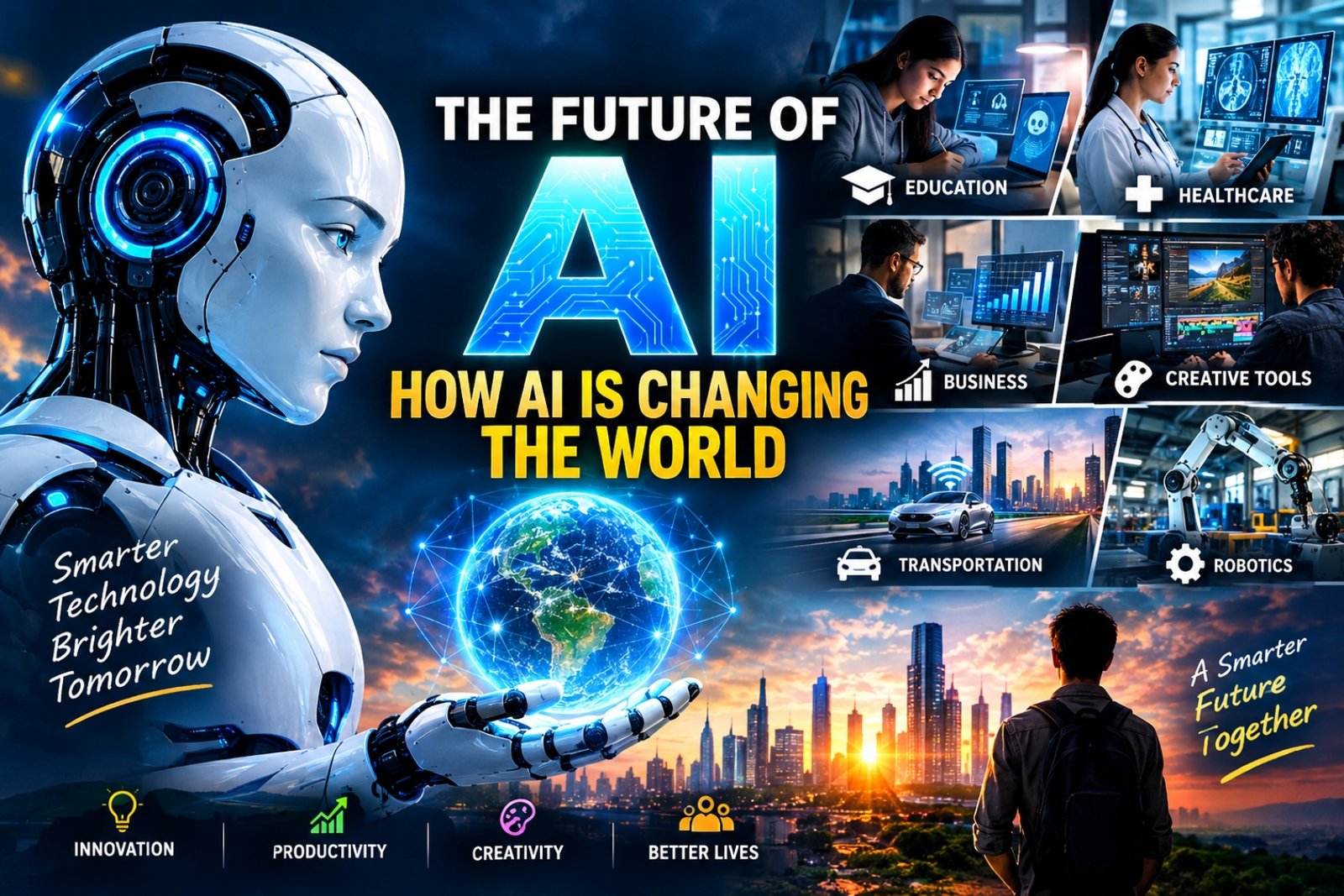
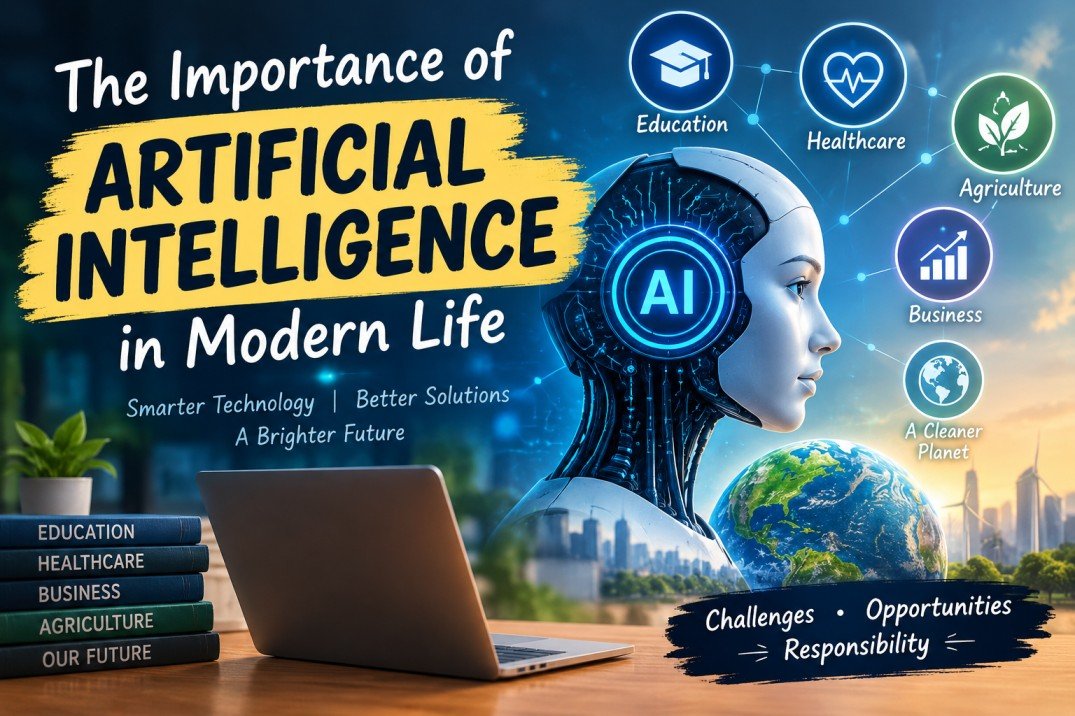
Introduction
Artificial Intelligence, commonly known as AI, is one of the most important technologies of the modern digital world. AI enables computers and machines to perform tasks that normally require human intelligence, such as learning, problem-solving, understanding language, recognizing images, making predictions and generating content. �
IBM +1
What is Artificial Intelligence?
Artificial Intelligence is a branch of computer science that develops systems capable of performing intelligent tasks. AI systems use data, algorithms and computing power to recognize patterns, make predictions and assist people in solving problems. Today, AI is used in smartphones, search engines, social media, online shopping, customer service, education, healthcare and many other areas. �
IBM
How Does AI Work?
AI systems generally depend on three important components: data, algorithms and computing power. Machine learning is a major part of AI. In machine learning, computers learn patterns from data and use those patterns to make predictions or decisions without needing every rule to be manually programmed. �
IBM
Generative AI
Generative AI is a type of AI that can create new content based on a user's instructions. It can generate text, images, audio, video and computer code. AI chatbots and other creative AI tools are examples of this technology. �
IBM
Uses of AI
AI has many practical applications in everyday life. Some common examples include:
AI chatbots for customer support
Voice assistants and speech recognition
Recommendation systems on shopping and entertainment platforms
Fraud detection in financial services
Medical data analysis
Weather and data forecasting
Image and video creation
Education and personalized learning
Manufacturing and industrial automation
Software and application development
Businesses also use AI to automate repetitive work, analyze large amounts of data, improve customer service and support decision-making. �
IBM
Benefits of AI
AI can save time by automating repetitive tasks. It can analyze large amounts of information quickly, provide useful insights and support people in making data-based decisions. AI systems can also operate continuously and help organizations improve efficiency and productivity. �
IBM
Challenges of AI
AI also has important challenges. These include privacy concerns, cybersecurity risks, incorrect or biased results, dependence on data and possible changes in employment for some types of work. Therefore, AI should be developed and used responsibly, with appropriate human oversight. �
IBM
AI and the Future
AI is expected to continue influencing many areas of society and business. Learning basic AI concepts can help students, workers and businesses understand new digital tools and use them effectively. At the same time, people should verify important AI-generated information and protect their personal data.
Conclusion
Artificial Intelligence is transforming the way people work, learn, communicate and create. From simple digital assistants to advanced generative AI systems, the technology is becoming an important part of modern life. The future of AI will depend not only on technological progress but also on responsible, secure and human-centered use.
हो 👍 खाली AI विषयावर अजून सुमारे 1,520 शब्दांचा विस्तृत Article Content देतो. हा तू Valtara Market मध्ये Article Content मध्ये थेट copy-paste करू शकतोस.
Artificial Intelligence (AI): The Technology Changing Our Future
Introduction
Artificial Intelligence, commonly known as AI, is rapidly becoming an important part of modern life. From smartphones and search engines to education, healthcare, banking, transportation and entertainment, AI is being used in many different areas. The main purpose of AI is to create computer systems that can perform tasks that normally require human intelligence. These tasks may include understanding language, recognizing images, learning from information, solving problems, identifying patterns and generating new content.
The development of AI has changed the way people interact with technology. In the past, computers mainly followed instructions given by humans. Modern AI systems can process large amounts of information, identify patterns and provide useful outputs based on the data they receive. This has created new opportunities for individuals, businesses, students, researchers and many other professionals.
What is Artificial Intelligence?
Artificial Intelligence is a field of computer science focused on developing machines and software that can perform intelligent tasks. AI does not mean that a computer has human emotions or consciousness. Instead, it refers to technologies that can perform specific tasks using algorithms, data and computational methods.
For example, when a smartphone recognizes a person's voice, an AI system is involved in processing the speech. When an online shopping platform recommends products based on previous activity, AI and machine-learning techniques may be used. Similarly, when an application automatically identifies objects in an image, computer vision technology may be involved.
AI can be designed for simple tasks as well as highly complex applications. The capabilities of an AI system depend on its design, training data, computing resources and the particular problem it is created to solve.
How Does AI Work?
AI systems generally work by processing information through algorithms. Data plays an important role in many AI applications. The system analyzes data to identify patterns and relationships that can be useful for a particular task.
Machine learning is one of the most important technologies used in AI. Instead of programming every possible situation manually, machine-learning systems can learn patterns from examples. For instance, a system designed to recognize images may be trained using many labeled examples. After training, it can use the learned patterns to classify new images.
Another important technology is natural language processing. It allows computers to process and generate human language. This technology is used in chatbots, translation applications, voice assistants, writing tools and search systems.
Computer vision is another area of AI that allows computers to analyze visual information. It can be used for object recognition, image classification, quality inspection and other applications.
Generative AI
Generative AI has become one of the most visible developments in artificial intelligence. Unlike systems that only classify or analyze existing information, generative AI can produce new content.
Depending on the system, generative AI can create text, images, audio, video and computer code. Users can provide instructions, commonly called prompts, and the AI system generates an output based on those instructions.
Students can use generative AI to understand difficult topics, create study outlines and practice questions. Content creators can use it for brainstorming ideas, writing drafts and developing creative concepts. Businesses can use it to assist with documents, customer communication and other repetitive tasks.
However, AI-generated content should not automatically be considered accurate. Users should review important information and verify facts before relying on it.
AI in Education
AI is creating new possibilities in education. Students can use AI-powered tools to receive explanations, practice questions and personalized learning assistance. AI can help explain the same topic in different ways depending on a student's level of understanding.
Teachers and educational institutions can also use AI for administrative tasks, content preparation and learning analysis. AI-powered systems may help identify areas where students need additional support.
At the same time, education systems need to consider responsible AI use. Students should continue developing their own understanding, reasoning and problem-solving skills instead of depending entirely on automated tools.
AI in Healthcare
Healthcare is another important area where AI technology is being researched and applied. AI systems can assist with analyzing medical images, organizing information, identifying patterns and supporting research.
For example, computer vision techniques can help analyze certain types of medical images. Machine-learning systems can also be used in research involving large datasets.
AI is generally intended to support healthcare professionals rather than replace them. Medical decisions can involve complex information and human judgment, so qualified professionals remain important.
AI in Business
Businesses are using AI for many different purposes. Customer-service chatbots can answer common questions. Recommendation systems can suggest products or services. AI can also help organizations analyze large amounts of business data.
Companies may use AI to identify patterns in customer behavior, automate repetitive processes and improve workflow efficiency. Marketing teams can use AI-assisted tools for content ideas and data analysis.
Small businesses can also benefit from accessible AI tools. For example, a small online store may use AI to create product descriptions, organize customer questions, generate promotional ideas and analyze basic sales information.
AI in Agriculture
Agriculture can also benefit from artificial intelligence. AI-powered systems can analyze information related to crops, weather and soil conditions. In some applications, computer vision can help identify plant diseases or monitor crop conditions.
Farmers and agricultural researchers can use data-driven systems to improve planning and resource management. AI can potentially assist with irrigation management, crop monitoring and agricultural forecasting.
The usefulness of such systems depends on the availability and quality of local data, technology infrastructure and user knowledge.
AI in Transportation
Artificial intelligence is increasingly being used in transportation systems. Navigation applications can analyze traffic information and suggest routes. AI can also support logistics companies by helping them plan deliveries and manage fleets.
Advanced driver-assistance technologies use sensors and software to detect objects, lanes and other information around a vehicle. Research into autonomous vehicles also relies heavily on AI, computer vision and other technologies.
Transportation AI aims to improve efficiency, safety and decision-making, but complex real-world environments create significant technical and safety challenges.
AI and Cybersecurity
AI can also be used in cybersecurity. Modern networks generate large amounts of information, making it difficult for humans to manually analyze every event.
Machine-learning systems can help identify unusual patterns and potentially suspicious activity. AI can assist security teams in monitoring systems and responding to certain types of threats.
However, AI can also be used by attackers to create more sophisticated scams, automated attacks and misleading content. This means cybersecurity professionals need to continuously improve defensive technologies and security practices.
Advantages of Artificial Intelligence
AI provides several potential advantages. One major advantage is automation. Repetitive tasks can sometimes be completed more quickly using software.
Another advantage is the ability to process large amounts of information. A computer system can analyze data at a scale that would be difficult for an individual person to handle manually.
AI can also provide assistance at any time. Digital assistants and automated customer-service systems can operate continuously.
AI may also support creativity. Generative AI tools can help people brainstorm ideas, create initial drafts and experiment with different forms of content.
Challenges and Limitations
Despite its advantages, AI has important limitations. One major concern is accuracy. AI systems can sometimes generate incorrect information or misunderstand a user's request.
Another concern is bias. If training data contains problematic patterns, an AI system may reproduce or amplify them. Therefore, developers need to carefully evaluate training data and system performance.
Privacy is also important. AI applications may process large amounts of information, and users should understand what data is being collected and how it is being used.
Security is another challenge. AI systems themselves can become targets for attacks, while AI can also be used to create new forms of digital threats.
AI and Employment
The growth of AI is influencing the world of work. Some repetitive tasks may increasingly be automated, while new roles related to AI development, data analysis, cybersecurity and technology management may grow.
The effect will differ between industries and occupations. In many cases, AI may change the tasks people perform rather than completely eliminate an occupation.
This makes digital skills increasingly valuable. Learning how to use AI tools responsibly, evaluate their outputs and combine them with human skills can be useful for students and workers.
Importance of Human Skills
Even as AI becomes more advanced, human skills remain important. Creativity, communication, critical thinking, teamwork, ethical reasoning and practical experience cannot simply be reduced to an AI tool.
People also need to evaluate AI-generated information. A good AI user does not blindly accept every output. Instead, they check important facts, consider the context and use their own judgment.
The most useful approach is often to treat AI as a tool that assists people rather than assuming that it can replace human decision-making in every situation.
AI and the Future
The future of artificial intelligence is likely to involve deeper integration into everyday applications. AI may become a normal feature of smartphones, computers, business software, educational platforms and many other digital services.
Future AI systems may become better at understanding different types of information, including text, images, audio and video. This could lead to more interactive digital assistants and new creative tools.
At the same time, governments, companies, researchers and users will need to address questions involving privacy, security, transparency, copyright, employment and responsible use.
How Students Can Learn AI
Students do not necessarily need advanced technical knowledge to begin learning about AI. They can start with basic concepts such as artificial intelligence, machine learning, data, algorithms and generative AI.
After understanding the basics, students can explore practical AI tools. They can learn how to write effective prompts, check AI-generated information and use AI for research and creative projects.
Students interested in technology can eventually learn programming languages such as Python and explore machine learning, data science and other technical fields.
Responsible Use of AI
Responsible AI use is important for everyone. Users should avoid sharing unnecessary sensitive information with AI tools. Important information should be verified using reliable sources.
AI should also be used honestly in education and professional environments. If an institution has rules about AI-generated content, users should follow those rules.
When AI is used to create content, people should understand its limitations and review the final result before publishing or submitting it.
Conclusion
Artificial Intelligence is one of the most significant technological developments of the modern era. It is already being used in education, healthcare, business, agriculture, transportation, entertainment, cybersecurity and many other fields.
AI can save time, process information, automate repetitive work and assist people with creative and analytical tasks. However, it also brings challenges involving accuracy, privacy, bias, security and employment.
The future of AI will depend not only on how powerful the technology becomes, but also on how responsibly people develop and use it. Understanding the basic principles of AI can help individuals make better use of modern technology.
AI should be viewed as a powerful tool that can support human creativity, knowledge and productivity. With responsible use, continuous learning and proper verification of information, AI can become an important part of the digital future.
KEYWORD : Artificial Intelligence, AI Technology, Machine Learning, Generative AI, Future of AI, AI Applications, Digital Technology