The Importance of Artificial Intelligence in Modern Life
Introduction
Artificial Intelligence, or AI, is one of the most rapidly developing technologies in the world. It is changing the way people work, study, communicate, travel, shop, and even make decisions. Although AI may sound like a highly advanced concept, many people already interact with it every day without realizing it.
Artificial Intelligence is a branch of computer science that focuses on creating machines and computer programs capable of performing tasks that normally require human intelligence. These tasks include learning, understanding language, recognizing images, solving problems, identifying patterns, and making predictions.
How Does Artificial Intelligence Work?
AI systems work by processing large amounts of information and identifying patterns within that information. Many modern AI systems use machine learning, in which computers learn patterns from data rather than being explicitly programmed for every individual situation.
For example, if an AI system is trained using thousands of pictures of cats and dogs, it can learn patterns that help it distinguish between them. The system does not think exactly like a human being; instead, it uses mathematical models and statistical patterns to produce an output.
Another important technology is deep learning, which uses artificial neural networks containing many layers. These systems are particularly useful for tasks such as speech recognition, image analysis, translation, and understanding complex patterns.
AI in Everyday Life
Artificial Intelligence has quietly become part of everyday life.
When YouTube or another streaming service recommends a video, algorithms analyze information about viewing behaviour to generate recommendations. Navigation applications can analyze traffic information and suggest routes. Online shopping platforms can recommend products based on searches and previous activity.
Smartphone cameras also use AI-based techniques to improve photographs. Face recognition, spam filtering, voice typing, translation, and predictive text are other examples of technology that may involve AI.
This shows that AI is not limited to robots or futuristic machines. Much of AI exists as software running in the background of digital services.
Artificial Intelligence in Education
AI is increasingly being used in education. Students can use AI-based learning tools to explain difficult subjects, practice questions, summarize information, improve writing, and learn languages.
Teachers can also use technology to create educational materials, organize information, and provide personalized learning activities.
However, students should not depend completely on AI. Education is not only about getting answers. It is also about developing critical thinking, creativity, communication, and problem-solving skills.
A student who uses AI to understand a difficult topic and then studies and solves problems independently can benefit from the technology. Simply copying AI-generated answers without understanding them can reduce learning.
AI in Healthcare
Healthcare is another important field where AI has significant applications. AI systems can assist researchers and medical professionals by analyzing large quantities of information and identifying patterns.
For example, computer vision systems can assist with the analysis of medical images. AI can also support drug research, help organize medical information, and assist in predicting certain risks.
AI does not eliminate the need for doctors and other healthcare professionals. Human expertise, communication, ethical judgment, and responsibility remain essential.
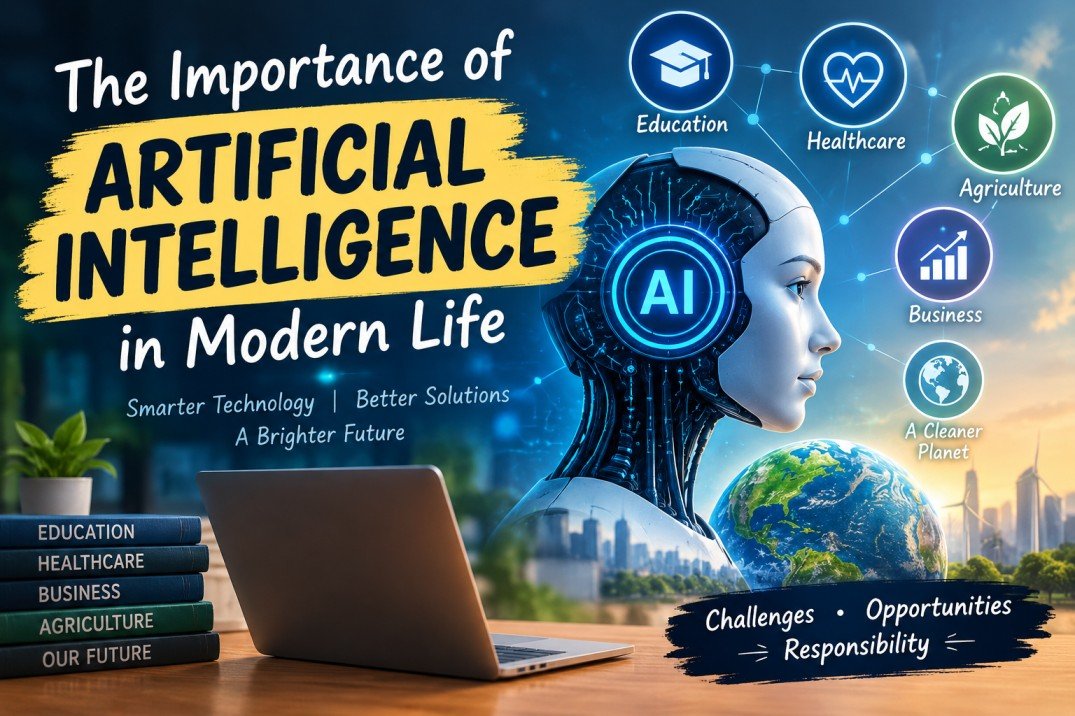
Artificial Intelligence, commonly known as AI, has become one of the most important technologies of the modern world. AI refers to computer systems that can perform tasks that normally require human intelligence, such as understanding language, recognizing images, solving problems, learning from information, and making predictions.
Today, AI is being used in many areas of everyday life. When we use voice assistants, watch recommended videos, use online maps, or receive personalized suggestions while shopping online, AI may be working behind the scenes. It has made many activities faster, easier, and more convenient.
AI is also changing education. Students can use digital tools to understand difficult concepts, practice languages, organize information, and receive assistance with their studies. Teachers can use technology to prepare learning materials and analyze students' progress. However, AI should be used as a learning aid rather than as a replacement for independent thinking.
In healthcare, AI can help doctors analyze medical images, identify patterns in large amounts of data, and support research. In agriculture, AI can help farmers monitor crops, predict weather conditions, and identify certain plant diseases. Businesses use AI for customer service, data analysis, fraud detection, and automation.
Despite its benefits, AI also creates important challenges. There are concerns about privacy, misinformation, job changes, bias in computer systems, and the misuse of technology. Therefore, developing AI responsibly is important. People need to understand both its advantages and its limitations.
The future of AI will depend not only on how powerful the technology becomes but also on how responsibly people use it. Learning about AI is therefore becoming an important part of digital knowledge. Instead of simply fearing or depending on AI, people should learn how it works, verify the information it provides, and use it thoughtfully.
In conclusion, artificial intelligence is changing the way people learn, work, communicate, and solve problems. It offers many opportunities, but it also requires responsibility. The ability to understand and use new technology wisely will be an important skill in the future.
Artificial Intelligence: Changing the World Around Us — Extended Article
A Brief History of Artificial Intelligence
The idea of creating machines that can imitate human intelligence is not new. Scientists and mathematicians began seriously exploring the concept of intelligent machines during the twentieth century. In 1950, British mathematician and computer scientist Alan Turing published an important paper discussing whether machines could think. He proposed a test, later known as the Turing Test, to examine whether a machine could communicate in a way that was difficult to distinguish from a human.
The term Artificial Intelligence became established as an academic field during the 1950s. Researchers began investigating whether computers could solve mathematical problems, play games, understand language, and perform logical reasoning.
The development of AI has not been continuous. There have been periods of great excitement followed by periods when progress and investment slowed. These periods are sometimes called AI winters. The recent rapid growth of AI has been supported by improvements in computer hardware, enormous datasets, cloud computing, and increasingly sophisticated machine-learning techniques.
Different Types of AI
AI can be discussed in several ways. One common classification is based on the capabilities of the system.
Narrow AI
Most AI systems available today can be described as narrow AI. They are designed to perform particular tasks or groups of related tasks.
Examples include recommendation systems, speech-recognition software, image-classification systems, translation tools, and fraud-detection systems.
These systems can be extremely capable within their designed areas but do not possess general human-like intelligence.
Artificial General Intelligence
Artificial General Intelligence (AGI) refers to a hypothetical type of AI that would be capable of performing a broad range of intellectual tasks at a level comparable to humans.
AGI remains a subject of research and debate. There is no universally accepted demonstration that such a system currently exists.
Superintelligence
Artificial superintelligence is a theoretical concept referring to a system whose intellectual capabilities would greatly exceed those of humans across many areas. It remains speculative rather than an established present-day technology.
Understanding these distinctions helps prevent confusion between real AI systems and fictional representations of intelligent machines.
Machine Learning and Deep Learning
Two important concepts behind modern AI are machine learning and deep learning.
Machine learning allows computers to identify patterns in data and use those patterns to make predictions or decisions. Instead of writing a separate rule for every possible situation, developers can train a model using examples.
Deep learning is a specialized approach based on artificial neural networks with multiple layers. It has contributed significantly to improvements in speech recognition, computer vision, natural-language processing, and generative AI.
The performance of these systems depends on many factors, including the quality of data, model design, computing resources, and evaluation methods.
Generative AI
A major recent development is generative AI. Unlike systems designed only to classify or predict information, generative AI can produce new content such as text, images, audio, video, and computer code.
Large language models can generate and transform text based on patterns learned during training. Image-generation systems can create pictures from written descriptions.
Generative AI can be useful for brainstorming, learning, programming assistance, content creation, and communication. However, generated content can contain errors or fabricated information. Therefore, users should verify important facts instead of assuming that every AI-generated response is correct.
Artificial Intelligence in Business
Businesses are increasingly using AI to improve productivity and analyze information.
Companies can use AI to identify patterns in customer behaviour, forecast demand, detect fraud, automate administrative tasks, and provide customer support.
For example, a company may analyze previous sales information to estimate future demand. A customer-service system may answer common questions automatically while transferring more complicated issues to human employees.
AI can therefore change the nature of work without necessarily eliminating an entire occupation. In many situations, individual tasks are automated while other tasks still require human involvement.
AI in Transportation
Transportation is another area affected by AI. Navigation applications can analyze road conditions and recommend routes. Transportation companies can use predictive systems to improve logistics and scheduling.
Research into autonomous vehicles also relies heavily on AI. Such vehicles need to interpret information from cameras, sensors, maps, and other systems to understand their surroundings.
However, transportation is a safety-critical field. AI systems must therefore undergo extensive testing, monitoring, and regulation before being trusted with important decisions.
AI in Agriculture
Agriculture can benefit from AI-based technologies as well. Farmers and agricultural researchers can use computer vision and data analysis to monitor crops and identify patterns.
AI can assist with detecting plant diseases, estimating crop conditions, monitoring irrigation, and analyzing environmental information.
Combining AI with satellite imagery, sensors, weather information, and agricultural knowledge can help improve decision-making. However, technology must be adapted to local conditions because farming practices differ between regions.
AI and Scientific Research
AI has become an important research tool. Scientists work with enormous quantities of data that can be difficult to analyze manually.
AI can help identify patterns, classify information, simulate processes, and generate hypotheses for further investigation.
In fields such as astronomy, biology, chemistry, climate science, and physics, computational methods can help researchers study complex problems.
AI does not replace the scientific method. Researchers still need to design experiments, examine evidence, test hypotheses, reproduce results, and evaluate uncertainty.
Ethical Questions Surrounding AI
The development of AI raises several ethical questions.
One important issue is accountability. If an AI system makes an incorrect or harmful decision, people need to understand who is responsible for designing, deploying, and monitoring the system.
Another issue is fairness. If training data contains historical biases, an AI system may reproduce those patterns. Developers therefore need appropriate testing and evaluation.
Transparency is also important. In some applications, users may need to know when they are interacting with an AI system or understand why an automated system produced a particular result.
There are also questions about intellectual property, data usage, privacy, and the environmental cost of large-scale computing.
AI Literacy
As AI becomes more common, AI literacy is becoming an important part of digital literacy.
AI literacy means understanding basic concepts such as data, algorithms, models, training, prediction, limitations, and verification.
A person does not need to be an AI researcher to become AI-literate. Basic knowledge can help people use AI tools more effectively and recognize misleading claims.
For example, an AI-generated photograph may look realistic but still represent something that never happened. Similarly, a confidently written AI response can contain factual errors.
Learning to verify information is therefore just as important as learning to use AI.
The Importance of Human Skills
The growth of AI does not make human skills irrelevant. In many situations, skills such as communication, empathy, leadership, creativity, teamwork, ethical reasoning, and critical thinking remain extremely valuable.
AI can process information quickly, but humans must determine what objectives are meaningful and what consequences are acceptable.
A good future skillset may therefore combine technological knowledge with human abilities.
For example, a person working in business may benefit from understanding both data analysis and communication. A programmer may use AI tools while still needing to understand software architecture and debugging. A student may use AI for explanations while developing independent reasoning.
AI and the Future of Education
Education may experience significant changes as AI becomes more capable.
Instead of treating every student exactly the same, technology may help provide personalized exercises and explanations. Students could receive additional practice in areas where they struggle.
At the same time, educational institutions may need to rethink assessment. If AI can easily generate essays or solve standard questions, teachers may increasingly focus on projects, discussions, demonstrations, and tasks that test genuine understanding.
This does not mean traditional learning becomes unnecessary. Fundamental knowledge remains important because people need a strong foundation to evaluate and use AI effectively.
Preparing for the Future
The best way to prepare for technological change is to develop a habit of continuous learning.
Students can begin with basic computer knowledge, then explore programming, data, cybersecurity, AI concepts, and digital communication. They can also develop skills outside technology, such as writing, public speaking, teamwork, and problem-solving.
The goal should not simply be to learn one particular AI tool. Tools change rapidly. Understanding fundamental concepts allows people to adapt when new technologies appear.
Conclusion
Artificial Intelligence represents a major development in the history of computing. From early experiments in machine reasoning to modern systems capable of generating text, images, code, and other forms of content, AI has developed enormously.
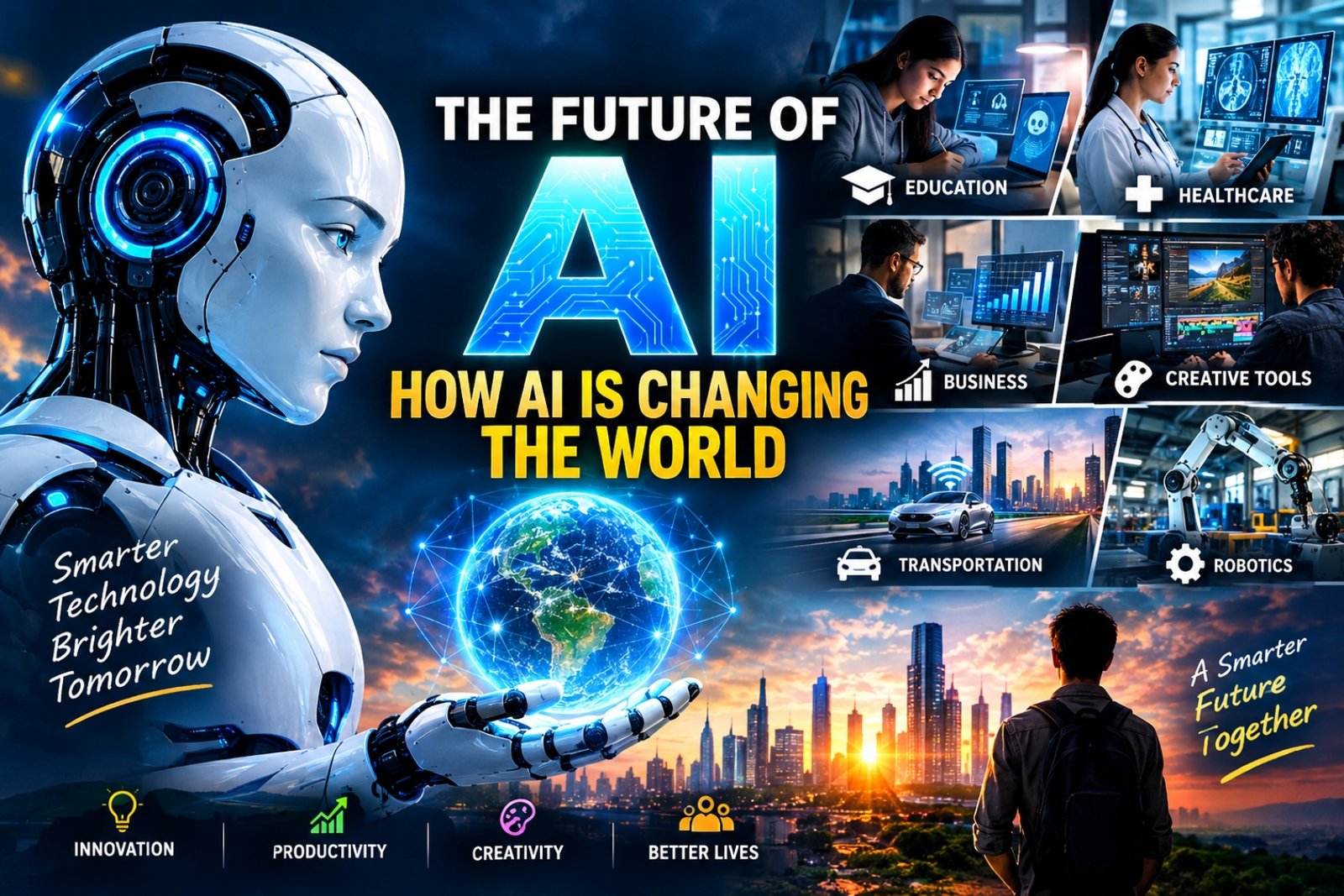
Its applications extend across education, healthcare, business, agriculture, transportation, science, cybersecurity, and entertainment. At the same time, AI introduces difficult questions about privacy, fairness, misinformation, employment, accountability, and responsible technological development.
The most important lesson is that understanding AI requires both curiosity and caution. People should learn what AI can do, understand what it cannot reliably do, and verify important information.
The future of artificial intelligence will be shaped not only by engineers and researchers but also by students, workers, businesses, governments, educators, and ordinary users. Developing technological knowledge alongside critical thinking and ethical awareness can help society make more informed decisions about this rapidly changing technology.
AI is therefore not simply a technology of the future. It is a technology that is already influencing the present, and understanding it is becoming an essential part of being digitally informed.