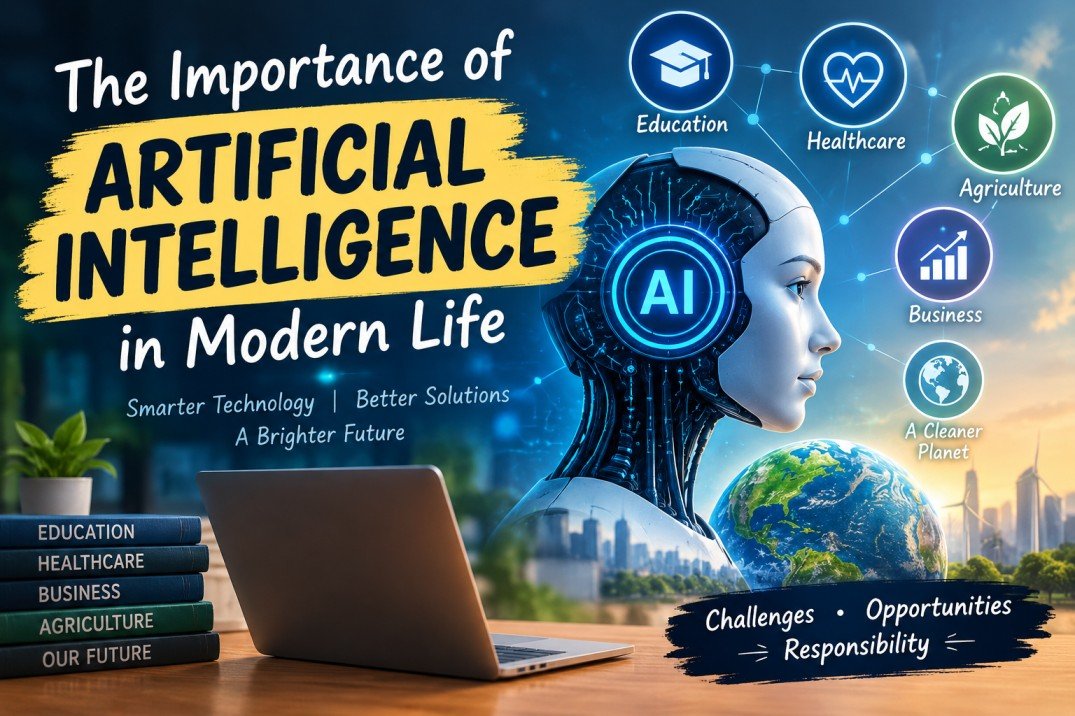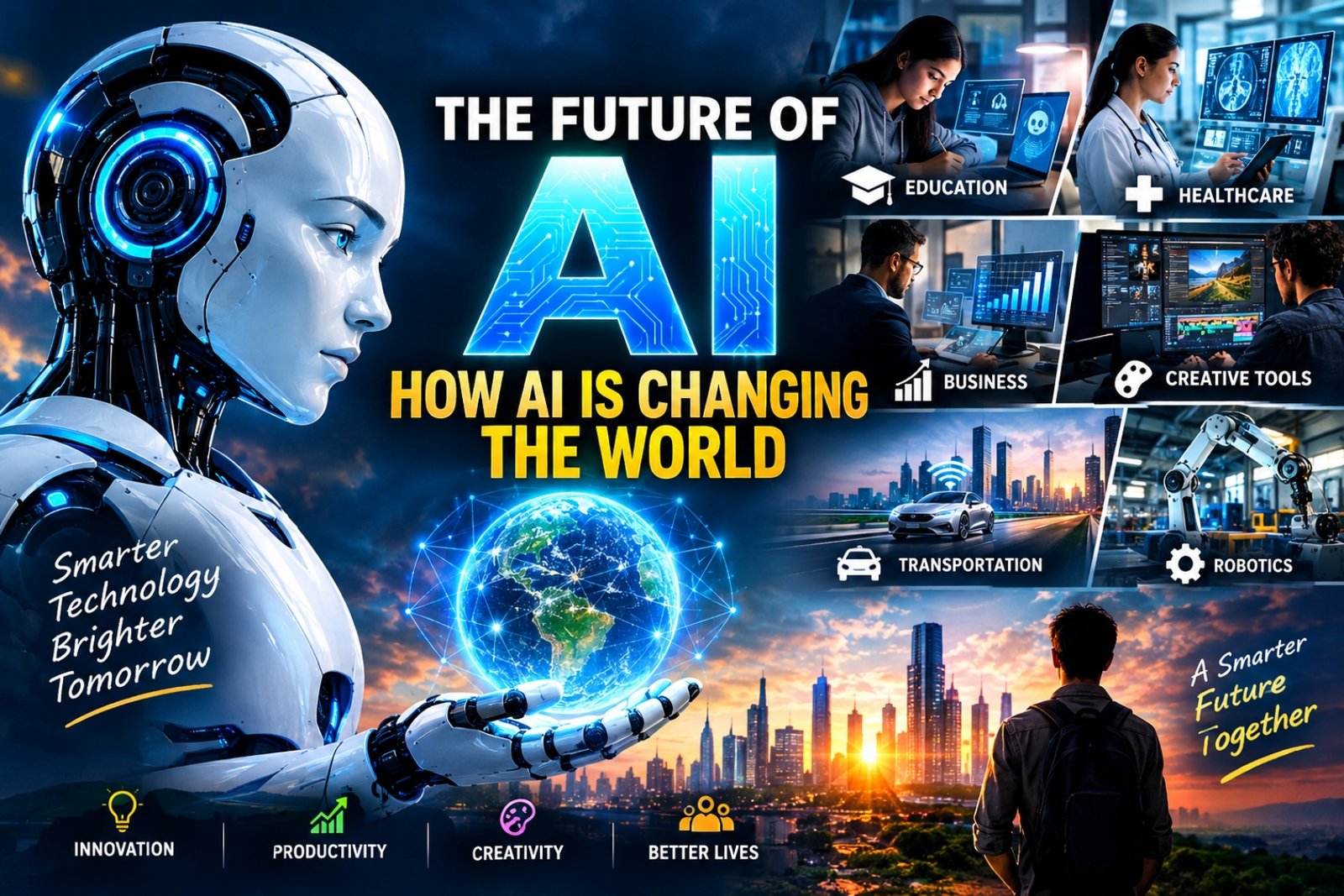
Artificial Intelligence, commonly known as AI, has become one of the most important technologies of the modern era. What once seemed like science fiction is now part of everyday life. People use AI when they search for information online, receive recommendations on streaming platforms, unlock smartphones with facial recognition, use navigation apps, interact with chatbots, edit photographs, translate languages, or generate text and images.
AI refers to computer systems designed to perform tasks that traditionally require human intelligence. These tasks can include understanding language, recognizing images, analyzing information, identifying patterns, making predictions, solving problems, and generating content.
The rapid development of AI is changing businesses, education, healthcare, entertainment, communication, transportation, and many other industries. At the same time, AI has created important discussions about privacy, employment, misinformation, security, copyright, and responsible technology use.
Understanding AI is therefore becoming increasingly important—not only for technology professionals but for students, business owners, creators, employees, and ordinary internet users.
What Is Artificial Intelligence?
Artificial Intelligence is a field of computer science focused on creating systems that can perform tasks associated with human intelligence.
Traditional computer programs generally follow instructions written by programmers. AI systems can go further by learning patterns from data and using those patterns to produce predictions, recommendations, classifications, or generated content.
For example, an AI-powered image system can analyze millions of examples of images and learn relationships between objects, colors, shapes, and visual concepts. A language model can learn patterns in large amounts of text and use those patterns to generate or transform language.
AI does not necessarily work like the human brain. Instead, different AI technologies use mathematical models, algorithms, data, and computing power to accomplish specific tasks.
How Does AI Work?
Modern AI often relies on machine learning, where computer systems learn patterns from data rather than being explicitly programmed for every possible situation.
A simplified AI process can be described in several steps:
Data collection: Large amounts of relevant information are gathered.
Training: An AI model analyzes the data to identify patterns.
Optimization: The model adjusts its internal parameters to improve its results.
Testing: The system is evaluated using information it has not previously seen.
Deployment: The trained model is used in a real-world application.
Improvement: Developers can evaluate performance and make further improvements.
One important area of machine learning is deep learning. Deep-learning systems use neural networks containing many layers of mathematical computations. These networks have become particularly effective for tasks involving images, speech, language, and complex patterns.
Generative AI
One of the biggest recent developments in AI is generative AI.
Unlike systems designed primarily to classify or predict information, generative AI can create new content based on a user's instructions. Depending on the system, it can produce:
Articles and other text
Images
Computer code
Audio
Video
Presentations
Summaries
Translations
Creative ideas
AI assistants based on large language models are an example of generative AI. They can understand natural-language instructions and produce responses in conversational form.
Image-generation systems can also create visuals from text descriptions. This has become particularly useful for designers, marketers, photographers, filmmakers, social-media creators, and businesses.
However, generated content still needs human review. AI systems can produce incorrect information, misunderstand instructions, or create details that appear convincing but are not factual.
AI in Everyday Life
Many people interact with AI without realizing how frequently they use it.
Search Engines
Modern search systems use AI and machine learning to understand queries, identify relevant information, and personalize aspects of the search experience.
Smartphones
AI is used in smartphone cameras, speech recognition, facial recognition, predictive text, battery optimization, translation, and many other features.
Social Media
Social platforms use algorithms to recommend posts, videos, accounts, and advertisements. These systems analyze user interactions and other signals to determine what content may be relevant.
Streaming Services
Movie and music platforms use recommendation systems to suggest content based on viewing or listening patterns.
Navigation
Navigation applications use data and algorithms to estimate travel times, identify traffic conditions, and suggest routes.
Online Shopping
E-commerce platforms use AI to recommend products, detect unusual activity, improve search results, and personalize parts of the shopping experience.
AI in Education
AI is changing how students learn and how teachers prepare educational materials.
AI tools can help students understand difficult concepts, generate practice questions, summarize information, translate text, and receive explanations at different levels of complexity.
Teachers can use AI to help prepare lesson plans, create educational activities, organize information, and develop examples.
However, education requires careful use of AI. Students should not simply submit AI-generated work as their own where that violates academic rules. Learning requires active thinking, practice, research, and independent understanding.
The most useful role for AI in education may be as a learning assistant rather than a replacement for teachers or students' own reasoning.
AI in Healthcare
Healthcare is another field where AI has significant potential.
AI systems can analyze medical images, identify patterns in large datasets, assist with administrative tasks, and support research. Researchers can also use machine learning to study biological information and investigate potential treatments.
AI may help healthcare professionals process large quantities of information more efficiently. However, medical decisions involve serious consequences, so AI systems require appropriate validation, oversight, privacy protections, and qualified human professionals.
AI should not automatically be treated as a replacement for doctors or other healthcare professionals.
AI in Business
Businesses are increasingly adopting AI to automate repetitive tasks and improve productivity.
Common applications include:
Customer-service chatbots
Document processing
Data analysis
Marketing assistance
Fraud detection
Demand forecasting
Software development
Sales support
Content creation
Workflow automation
Small businesses can also use AI to generate marketing ideas, draft emails, analyze information, create promotional material, and improve customer communication.
The biggest advantage is often not simply replacing human work. AI can help people complete certain tasks faster, allowing them to spend more time on activities requiring judgment, creativity, communication, and decision-making.
AI and Employment
The impact of AI on employment is one of the most widely discussed issues surrounding the technology.
AI can automate some tasks that people currently perform. Jobs involving repetitive, predictable, or highly structured activities may experience greater automation pressure.
At the same time, technological change can create new occupations and new types of work. AI is already increasing demand for skills related to data, software, AI system development, cybersecurity, digital content, and technology management.
The effect of AI is therefore more complicated than simply saying that AI will "take all jobs."
In many occupations, AI may change the tasks people perform rather than eliminate the entire occupation. Workers who learn how to use AI effectively may be able to increase their productivity.
This makes reskilling and continuous learning increasingly important.
AI for Content Creators
AI has become particularly useful for photographers, video editors, graphic designers, writers, and social-media creators.
Creators can use AI to brainstorm ideas, generate scripts, remove backgrounds, improve images, create visual concepts, produce subtitles, translate content, and automate repetitive editing tasks.
For a video editor, for example, AI can assist with transcription, scene organization, noise reduction, caption generation, image enhancement, and other workflow tasks.
However, creativity is not simply about producing content quickly. Human storytelling, taste, emotion, cultural understanding, and creative direction remain important.
AI can be a powerful creative tool, but the final quality often depends on how effectively a person guides, evaluates, and edits the output.
AI and Cybersecurity
AI has applications in cybersecurity as well.
Security systems can use machine learning to identify unusual patterns, detect potentially malicious behavior, and analyze large volumes of security information.
At the same time, attackers can also use AI to automate certain activities. This creates an ongoing technological competition between defensive and offensive capabilities.
Organizations therefore need strong security practices, including secure software, access controls, employee awareness, monitoring, and regular system updates.
Challenges and Risks of AI
Despite its benefits, AI presents significant challenges.
Incorrect Information
AI systems can sometimes generate false or misleading information. A confident-sounding response is not automatically a correct response.
Privacy
AI systems can process large quantities of information, raising questions about how personal data is collected, stored, and used.
Bias
AI models can reproduce or amplify patterns and biases present in their training data or development processes.
Deepfakes and Misinformation
AI-generated images, audio, and video can make it easier to create convincing false material. This creates challenges for journalism, social media, public institutions, and ordinary users.
Copyright and Ownership
The use of copyrighted material in AI development and the ownership of AI-generated content are subjects of continuing legal and policy debate in different countries.
Security
AI systems can introduce new security risks if they are poorly designed, improperly deployed, or connected to sensitive systems.
Responsible Use of AI
The future of AI depends not only on technological progress but also on responsible use.
Users should verify important information rather than blindly trusting AI-generated answers. Organizations should consider privacy, security, transparency, and accountability when deploying AI systems.
Human oversight is particularly important when AI is used for high-impact decisions.
People should also understand the limitations of AI. AI can be extremely useful while still making mistakes. Treating AI as a tool rather than an unquestionable authority is an important principle.
The Future of Artificial Intelligence
AI development is likely to continue across many areas.
Future systems may become more capable of working across different types of information, including text, images, audio, video, and software. AI assistants may become more deeply integrated into workplaces and personal productivity tools.
Robotics could also benefit from advances in AI, potentially enabling machines to perform more complex physical tasks.
At the same time, governments, companies, researchers, and communities will continue discussing how AI should be developed and regulated.
The future will likely not be defined by AI alone. Instead, it will be shaped by the interaction between people, AI systems, institutions, and society.
Conclusion
Artificial Intelligence is transforming the digital world and changing how people work, learn, create, communicate, and solve problems. From smartphones and search engines to generative AI and advanced research, the technology has become an important part of modern life.
AI offers enormous opportunities for productivity, creativity, scientific research, education, and business. But it also introduces challenges involving privacy, misinformation, employment, bias, security, and responsible use.
The most important skill in the AI era may not be simply knowing how to use an AI tool. It is knowing when to use it, how to give it effective instructions, how to verify its output, and where human judgment is necessary.
AI is likely to remain one of the defining technologies of the coming years. People and organizations that understand both its possibilities and its limitations will be better prepared to participate in an increasingly AI-driven world.
AI and Human Creativity
Artificial Intelligence is also changing the way people think about creativity. In the past, creating professional-looking content often required expensive software, technical knowledge, and considerable time. Today, AI-powered tools can help users generate ideas, write drafts, create images, edit videos, improve photographs, and experiment with different creative styles.
For content creators, AI can act as a creative assistant. A photographer can use AI to remove unwanted objects, improve image quality, or create different visual concepts. A video editor can use AI for subtitles, transcription, background removal, audio enhancement, and other repetitive tasks. Writers can use AI to brainstorm topics, organize ideas, and improve drafts.
However, human creativity remains important. AI can generate many possibilities, but humans decide which ideas are meaningful, appropriate, original, and useful. A successful creative project usually depends on a combination of technology and human direction.
AI and Small Businesses
AI is not limited to large technology companies. Small businesses can also benefit from affordable AI tools. A local business can use AI to prepare social-media posts, answer common customer questions, translate content, create promotional ideas, analyze basic business information, and organize routine tasks.
For entrepreneurs, AI can reduce the time required for certain administrative and creative activities. This can allow business owners to focus more on customers, products, services, and strategy.
Learning AI Skills
As AI becomes more common, learning basic AI skills can be valuable. People do not necessarily need to become programmers to benefit from AI. Understanding how to write clear prompts, verify information, protect personal data, and evaluate AI-generated content can be useful across many professions.
Students and professionals can also develop complementary skills such as communication, critical thinking, creativity, problem-solving, and subject-matter expertise. These abilities can help people work effectively with AI rather than simply depend on it.