
credit score is one of the most important numbers in your financial life. Whether you are planning to take a personal loan, home loan, car loan, or credit card, your credit score can play an important role in how lenders assess your creditworthiness.
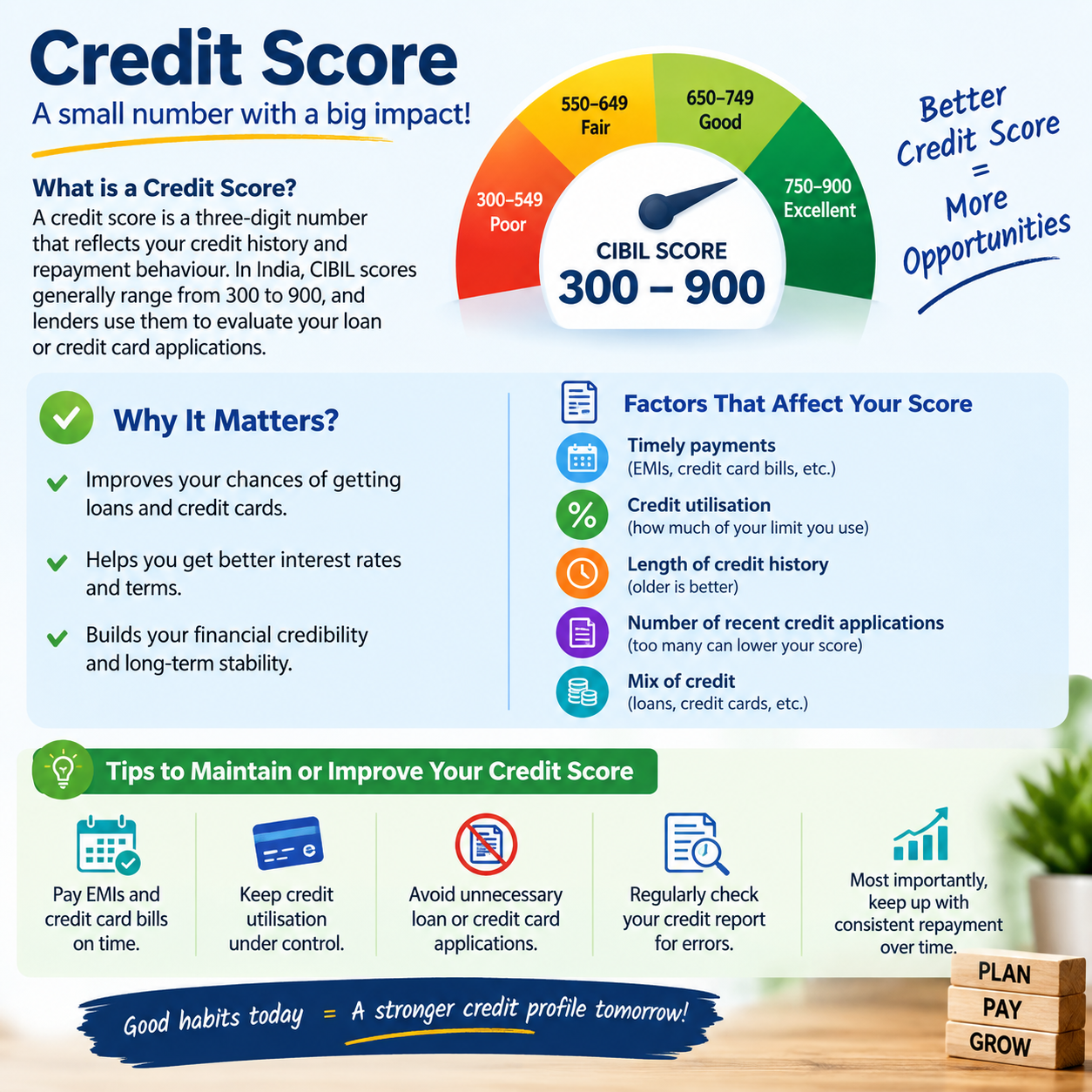
In India, the CIBIL score is one of the most commonly known credit scores. It is generally expressed on a scale of 300 to 900. A higher score generally indicates a stronger credit history, while a lower score may make it more difficult to obtain credit or may result in less favourable lending terms.
However, a credit score is not simply a number. It represents your past credit behaviour, including how consistently you have repaid loans and credit-card dues, how much of your available credit you use, how frequently you apply for new credit, and how long you have maintained credit accounts.
Understanding how credit scores work can help you make better financial decisions and avoid mistakes that could negatively affect your credit profile.
What Is a Credit Score?
A credit score is a three-digit numerical representation of information contained in your credit history. Credit bureaus calculate the score using information reported by banks, financial institutions, and other lenders.
In India, credit information companies maintain records related to an individual’s borrowing and repayment history. CIBIL, operated by TransUnion CIBIL, is one of the major credit information providers.
Your credit report may contain information about:
- Personal and secured loans
- Credit cards
- Repayment history
- Outstanding balances
- Credit limits
- Loan accounts
- Account status
- Recent credit enquiries
- Defaults or overdue payments
This information is used to assess your past credit behaviour.
A credit score therefore gives lenders a quick indication of how you have managed credit in the past. However, lenders generally consider several other factors before approving a loan or credit card. Income, employment, existing obligations, lender policies, and other eligibility criteria can also influence the final decision.
Understanding the CIBIL Score Range
CIBIL scores are generally represented between 300 and 900.
A commonly used broad interpretation is:
- 300–549: Poor
- 550–649: Fair
- 650–749: Good
- 750–900: Excellent
These ranges are useful for understanding the general position of a credit score, but lenders may have different internal policies and eligibility criteria.
For example, two people with similar credit scores may receive different loan decisions because their income, existing debt, employment history, loan amount, or other financial circumstances may be different.
Therefore, your credit score should be viewed as one component of your overall financial profile rather than the only factor determining whether a loan will be approved.
Why Is a Credit Score Important?
A strong credit history can provide several financial advantages.
1. It Can Support Loan Applications
When you apply for a loan, lenders generally review your credit history as part of their assessment. A positive repayment record can demonstrate that you have previously managed credit responsibly.
This can be particularly important when applying for:
- Home loans
- Personal loans
- Car loans
- Business loans
- Education loans
- Credit cards
However, approval is never guaranteed solely because of a particular credit score.
2. It Can Influence Loan Terms
Credit history may also be considered when lenders determine the terms of a credit facility.
Depending on the lender and the overall application, a stronger credit profile may support access to more favourable terms, while a weaker credit history may lead to additional scrutiny.
3. It Helps Build Financial Credibility
Your credit history develops over time. Consistently paying EMIs and credit-card bills on schedule demonstrates responsible borrowing behaviour.
This creates a record that lenders can consider when evaluating future applications.
4. It Can Be Important for Large Financial Goals
A credit score can become particularly important when you are planning major financial commitments.
For example, buying a house may involve a substantial home loan. Maintaining a healthy credit profile well before applying for such financing can be an important part of financial preparation.
What Factors Affect Your Credit Score?
Several factors can influence your credit score. The exact calculation methodology is determined by the relevant credit bureau, but responsible credit management generally focuses on the following areas.
1. Payment History
Payment history is a very important part of credit management.
Missing EMI payments or failing to pay credit-card dues on time can negatively affect your credit history. Repeated late payments may be particularly damaging because they indicate difficulty in managing existing credit obligations.
The simplest habit is therefore:
Pay your EMIs and credit-card bills on time.
Setting up reminders or appropriate automatic payment arrangements can help prevent accidental missed payments.
2. Credit Utilisation
Credit utilisation refers to how much of your available revolving credit limit you are using.
For example, suppose your credit-card limit is ₹1,00,000 and your outstanding balance is ₹30,000. Your utilisation would be 30%.
High utilisation over time can indicate that you are relying heavily on available revolving credit. Keeping utilisation under control is therefore an important credit-management practice.
It is also important to remember that having a high credit limit does not mean you should use the entire limit.
3. Length of Credit History
The age of your credit accounts can also be relevant to your credit profile.
A longer, well-managed credit history can provide more information about your borrowing behaviour. This is one reason why unnecessarily closing an old, well-managed credit account may not always be beneficial.
Before closing an old account, consider its age, annual fees, utilisation impact, and whether you actually need it.
4. Recent Credit Applications
Every time you apply for credit, the lender may make a credit enquiry.
Making multiple credit applications within a short period can result in several enquiries appearing on your credit report. A large number of recent enquiries may be viewed differently by lenders depending on their policies.
Therefore, avoid applying for multiple loans or credit cards simply to see which one gets approved.
Instead, compare eligibility requirements and apply selectively.
5. Credit Mix
Your credit profile may contain different types of credit, such as secured and unsecured loans.
Examples include:
- Home loans
- Vehicle loans
- Personal loans
- Credit cards
- Education loans
A healthy credit profile is generally associated with responsible management of the credit you actually need. There is no need to borrow unnecessarily just to create a particular credit mix.
How to Improve a Low Credit Score
Improving a credit score is usually a process rather than a quick activity.
If your score is low, focus on building consistent positive credit behaviour.
Pay All Overdue Amounts
If you have overdue EMIs or credit-card payments, clearing them is an important first step.
After making payments, allow the lender and credit bureau time to update the information. Credit-report updates are not necessarily instantaneous.
Keep records of your payments and check your credit report periodically to confirm that the account information has been updated correctly.
Never Miss Future EMI Payments
Once overdue amounts have been cleared, maintaining a clean repayment record becomes important.
Create an EMI calendar showing:
- Loan name
- EMI amount
- Due date
- Payment status
You can also use reminders or automatic payment arrangements where appropriate.
Reduce Credit-Card Balances
If your credit-card utilisation is high, gradually reducing the outstanding balance can help you manage your overall debt burden.
Avoid using a credit card as a source of long-term borrowing if you cannot comfortably repay the balance.
Credit cards are generally most useful when they are used within a planned budget and the dues are paid according to the card’s terms.
Avoid Unnecessary Loan Applications
If your credit score is already weak, repeatedly applying for loans or credit cards may not be a sensible strategy.
First understand why your score is low. Review your credit report, identify overdue accounts or errors, and work on improving your repayment behaviour.
Check Your Credit Report
Checking your credit report regularly can help you identify problems early.
Look for:
- Accounts that do not belong to you
- Incorrect overdue amounts
- Incorrect account status
- Duplicate accounts
- Incorrect personal information
- Payments that have not been properly reflected
- Unrecognised credit enquiries
If you find an error, contact the relevant lender or credit bureau and follow the appropriate dispute process.
How Long Does It Take to Improve a Credit Score?
There is no universal number of days or months required for a credit score to improve.
The timeline depends on the reason for the low score and the information being reported.
For example, if your score has been affected by overdue payments, clearing those dues is an important first step. However, the positive impact of consistent repayments generally develops over time as new payment information is reported.
If your credit history contains several negative events, rebuilding your profile can take longer.
The key principle is simple:
Credit improvement is based on consistent financial behaviour, not a one-time payment.
Does Checking Your Own Credit Score Reduce It?
People sometimes avoid checking their credit score because they believe every check will reduce their score.
It is important to distinguish between checking your own credit information and a lender making a credit enquiry as part of a new application.
Reviewing your own credit report is an important financial-management habit. It allows you to identify inaccuracies and understand your current credit position.
Before applying for new credit, it is therefore sensible to understand your existing credit profile.
Credit Score and Home Loans
A credit score can become especially important when purchasing a house because home loans generally involve substantial amounts and long repayment periods.
Before applying for a home loan, consider reviewing your credit profile several months in advance.
You can prepare by:
- Clearing overdue accounts.
- Paying all existing EMIs on time.
- Reducing unnecessary outstanding credit-card balances.
- Avoiding multiple new credit applications.
- Checking your credit report for errors.
- Maintaining stable financial records.
- Preparing documentation related to income and existing liabilities.
A good credit profile does not guarantee home-loan approval, because lenders also consider property details, income, employment, existing obligations, documentation, and their own lending policies.
Credit Score and Credit Cards
Credit cards can be useful financial tools when managed responsibly.
For example, using a credit card for planned expenses and paying the dues according to the card’s terms can help establish a repayment history.
However, problems can arise when a card is consistently used beyond the user’s ability to repay.
Good credit-card habits include:
- Keep spending within your budget.
- Monitor your available credit.
- Pay bills on time.
- Avoid unnecessary cash advances.
- Avoid carrying large balances unnecessarily.
- Review statements for incorrect transactions.
- Avoid applying for multiple cards without a clear purpose.
Remember that a credit card is not additional income. It is a credit facility that must be managed responsibly.
Common Credit Score Myths
Myth 1: Closing Every Loan Improves Your Score Immediately
Closing a loan can change your credit profile, but it does not automatically mean your score will immediately increase.
What matters is the overall information in your credit history.
Myth 2: Borrowing More Money Automatically Builds a Better Score
You do not need to take unnecessary loans simply to build your credit score.
Responsible management of existing credit is more important than borrowing for the sake of borrowing.
Myth 3: A Single Late Payment Has No Effect
Late payments can be reported and may affect your credit history. It is therefore important to take every EMI and credit-card due date seriously.
Myth 4: Income Determines Your Credit Score
Your salary and credit score are different concepts.
Income can be important for loan eligibility, but a credit score primarily reflects information related to your credit history and reported credit behaviour.
Myth 5: Credit Score and Loan Eligibility Are the Same Thing
They are not.
Your credit score is one part of a broader lending assessment. A lender may also consider income, employment, debt obligations, property details, documents, internal policies, and other factors.
Steps to Build a Strong Credit Profile
Building a strong credit profile requires discipline and consistency.
A simple monthly routine can help:
Step 1: Check upcoming EMIs
Know exactly how much needs to be paid and on what date.
Step 2: Monitor credit-card spending
Keep your spending within a manageable level.
Step 3: Maintain an emergency fund
An emergency fund can reduce the need to depend on high-cost credit when unexpected expenses occur.
Step 4: Avoid unnecessary applications
Only apply for credit when there is a genuine financial requirement.
Step 5: Review your credit report
Periodically check your credit information for accuracy.
Step 6: Keep records
Save payment confirmations and important loan documents.
Step 7: Be patient
Credit history is built over time. Consistency is more important than trying to increase the score through quick fixes.
Credit Score Is a Financial Responsibility Indicator
A credit score should not be viewed simply as a number that needs to be increased.
The real objective should be to develop healthy financial habits.
A person who pays bills on time, keeps debt manageable, avoids unnecessary borrowing, and regularly monitors their credit report is generally taking responsible steps toward maintaining a healthy credit profile.
A strong credit profile can also make future financial planning easier because you have a clearer understanding of your borrowing capacity and repayment obligations.
Final Thoughts
Your credit score is an important part of your overall financial profile. It reflects aspects of your credit history and can be considered by lenders when you apply for loans or credit cards.
Maintaining a healthy credit profile does not require complicated strategies. The fundamentals are straightforward:
Pay on time. Borrow responsibly. Keep credit utilisation under control. Avoid unnecessary applications. Check your credit report. Correct errors. Stay consistent.
If your current score is lower than you would like, do not focus only on the number. Identify the reasons behind the score, clear genuine overdue amounts, maintain timely repayments, and allow your positive financial behaviour to build a stronger history over time.
Ultimately, good financial habits today can contribute to a stronger credit profile tomorrow.